Metal Roofing in Cooper, TX
For metal roofing in Cooper, DJJ Roofing covers Delta County from our shop in Sulphur Springs. Cooper is half an hour north of the shop, one of the closer towns we cover outside Hopkins County. You get a roof walked properly, photographs of everything we find, and a written estimate you can take away and think about.
- Standing seam and exposed-fastener panel
- Homes, shops, barns and commercial buildings
- Free inspection and written estimate

Metal roofing for Cooper homes and buildings
On the roofs we work on around Cooper, metal covers two quite different products that get talked about as one. Which one suits a Cooper building depends on what is underneath it and what you want out of it.
Everything below is included in the price we quote for metal roofing in Cooper. There is no separate line for showing up, no charge for the inspection, and nothing added afterwards that was not on the estimate you agreed to before the work started.
That is the scope every quote for metal roofing in Cooper is written against.
Standing seam
Panels lock together at a raised seam and the fasteners are concealed underneath. Nothing is exposed to work loose, which is why hail on standing seam is usually a cosmetic matter rather than a leak path. On a Cooper roof that is part of the same visit rather than a separate call-out.
Panel layout worked out first
Set out from real measurements so the runs land correctly at both ends. Layout is what decides whether a metal roof looks right from the street, and it cannot be fixed afterwards. We do this on every Cooper job whether or not anybody thinks to ask for it.
Finish and gauge named in writing
The estimate says which profile, which gauge and which coating system. Those three decide how the roof looks in fifteen years, and they are easy to leave vague. It is included in the price quoted for a Cooper address, never billed after the fact.

The building stock around Cooper
Cooper is the Delta County seat and sits in farmland between the forks of the Sulphur River. The roof stock is weighted toward older homes, a good number of them farmhouses that have been re-roofed more than once, plus working agricultural buildings running exposed-fastener metal.
Cooper is half an hour north of the shop, one of the closer towns we cover outside Hopkins County. That matters more than it sounds. A crew that works the same counties every week already knows which subdivisions went up with builder-grade shingle and which older streets have the cut-up rooflines where flashing does the real work.
It also means the office that writes your estimate is the office that answers the phone in year three. You can read more about the town itself on our Cooper page, or about the service generally on our Metal Roofing page.
The short version is that we are close enough to Cooper to be useful and small enough to care whether the job was right. Both of those matter more in year three than they do on the day.
The three things Cooper roofs take
Delta County is open farmland, which means wind reaches a roof with almost nothing in the way, and the county takes the same spring hail as the rest of Northeast Texas. None of it is dramatic on the day. It is cumulative, and it is why a roof here rarely reaches the number of years printed on the wrapper without somebody looking at it.
That is what the free inspection is for. Before we quote metal roofing in Cooper we photograph every slope, so you can see which of these has actually happened to your roof rather than guessing at it from the ground.
All of it feeds into what metal roofing in Cooper actually has to address.
Spring hail
March through June is when Delta County takes most of its hail. The damage that matters is bruising and granule loss, neither of which leaks on the day and both of which shorten the roof.
Straight-line wind
Wind does not need to remove a shingle to do harm. Lifting a tab far enough to break the self-seal strip is enough, and the shingle lies back down looking untouched.
Summer heat
Texas summers cook a roof from both sides. Where attic ventilation is not balanced, the heat builds underneath and takes years off the shingle above it.
The Cooper picture, specifically
Thirty minutes from the shop, straight north, which makes Cooper one of the easier towns for us to reach. We usually cover it alongside Brashear and Sulphur Bluff, so a job there rarely waits on a dedicated trip.
Homeowners and farm owners in roughly equal measure, and a good share of the work arrives through somebody who already knows a job we have done nearby.
What we work on here
Older farmhouses and in-town housing, plus the working buildings that go with farmland: equipment sheds, shops and barns, nearly all metal. Full replacements are a larger share of what we do in Cooper than in newer towns, because a good deal of the housing is old enough to be on its second or third roof.
What we get called for
Full replacements more often than repairs. On a farmhouse roof that has been covered twice already, the interesting question is what the decking is doing, and a tear-off in Cooper turns up sheets needing attention more often than it does on newer stock.
How the year runs here
Spring hail sets the pace, as it does across the region, and the agricultural side adds its own rhythm: work on sheds and barns gets scheduled around what the farm is doing rather than around the weather.
Longer life, and a different failure mode
For Cooper property owners, metal is neither maintenance free nor indestructible. It outlasts asphalt comfortably and it fails in different places, which is worth knowing before choosing it.
The common thread is that all of it starts small. Caught early on a Cooper roof these are modest repairs; left through another storm season they become the reason a roof comes off years ahead of schedule.
Fasteners, on exposed systems
Screws back out and neoprene washers harden over the years. On an exposed-fastener roof this is the thing to check every few years, and it is inexpensive to put right. Regular enough at Cooper addresses that we look for it first.
Movement and oil canning
Metal expands and contracts. Clip systems and correct panel lengths handle it. Slight waviness in a flat pan is a cosmetic characteristic of the product, not a defect. It accounts for a real share of the Cooper roofs we are called to.
Dissimilar metals
The wrong fastener against the wrong panel corrodes at the contact point. It looks like nothing for years and then it is a hole. This turns up across Delta County on roofs of every age.
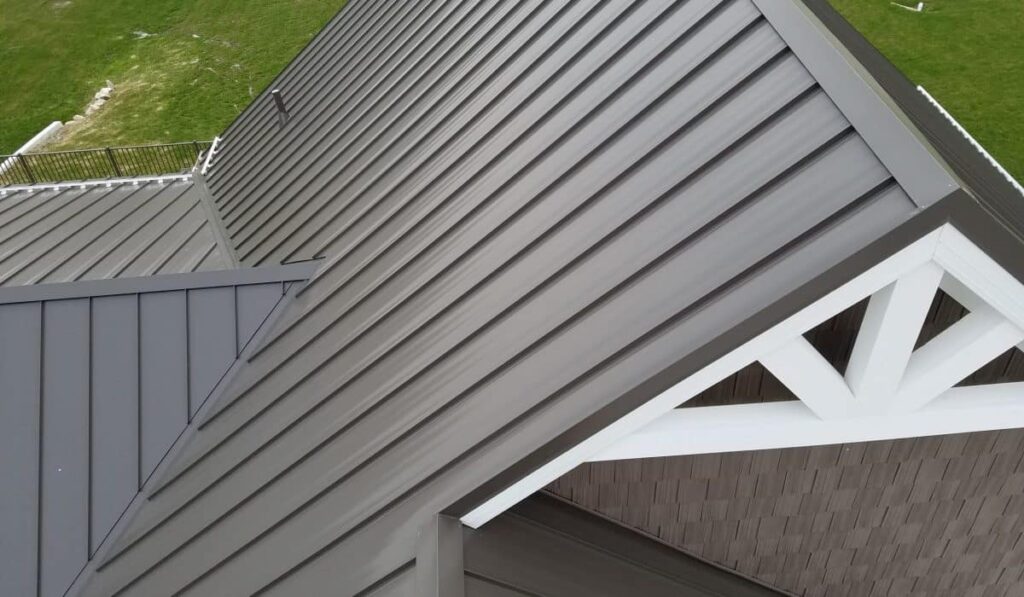
How a metal roof goes on in Cooper
For Cooper property owners, metal takes longer than shingle and depends far more on preparation. Rushing the layout is how a metal roof ends up looking wrong from the street.
The whole sequence normally runs from your first call to a finished roof inside two weeks for a Cooper address, and faster where there is an active leak. Weather is the only thing that regularly moves a date.
Measure and inspect
Panel layout is worked out from real measurements, not an estimate. Decking and structure get checked at the same time. It happens on every Cooper job regardless of size.
Written estimate
Written down with the profile and gauge named, so you know exactly what is being quoted. The same sequence runs at every Cooper address.
Preparation
Tear-off where needed, decking repairs, then underlayment suited to a metal system rather than a shingle one. The same on a small repair and a full replacement in Cooper.
Panels and trim
Panels set out so the layout lands correctly at both ends, then ridge, eave, rake and penetration trim. Standard on all our Delta County work.
Walkthrough
Every closure and penetration checked with you, and the site cleared of offcuts and stray fasteners before we go. We follow this on every property we work on around Cooper.
Six things to check on a Cooper metal roof
At a Cooper address, metal lasts a long time and it is not maintenance free. Nearly everything that goes wrong happens at a fastener, a seam or a piece of trim rather than in the panel.
None of these is an emergency on its own. Together they are usually the difference between a repair this season and a replacement two seasons from now, which is a large enough gap to be worth an hour of somebody’s time.
Hardened or split washers
The neoprene washer under the screw head is what actually seals. It ages faster than the panel and is inexpensive to replace. We see this regularly at Cooper addresses, particularly after a wind event.
Dents after hail
On standing seam these are usually cosmetic. On exposed-fastener panel a hard hit near a screw is worth a proper look. Common enough on Cooper roofs that we check for it on every inspection.
Staining below a seam or penetration
A rust line or a stain running down from one point usually marks exactly where water is getting in. We see this regularly at Cooper addresses, particularly after a wind event.
Gaps in ridge or eave closures
The foam or metal closures that seal the profile at top and bottom perish before the panel does, and open the roof to wind-driven rain. We photograph it on every Cooper inspection where it is present.
Water staining on the underside of decking
Visible from the attic, and on metal it usually points at condensation or a closure rather than a hole. It turns up often on older properties around Cooper.
Scratches down to bare metal
Usually from a branch or a boot. Treated early they stay cosmetic; left alone they are where rust starts. Worth a look from the ground at any Cooper address after a storm.
The profiles we install around Delta County
Across Delta County, profile is not a styling decision. It determines how the roof is fastened, how it handles hail and how low a pitch it can go on.
Any of these can be the right answer in Delta County. The wrong answer is the one chosen without anybody looking at the roof first, which is why the inspection comes before the recommendation rather than after it.
Worth reading elsewhere: the Metal Construction Association covers panel profiles and expected service life, and the National Roofing Contractors Association publishes the installation standards metal roofing is built to.
PBU panel
Exposed-fastener panel used widely on walls and roofs of utility buildings. Economical and straightforward to install over purlins. We have put a lot of this on buildings around Cooper.
Corrugated panel
The traditional wavy profile. Still the right look and the right price on barns and outbuildings around Cooper. Worth considering on most Cooper properties, and we will say when it is not.
Underlayment for metal
Metal needs an underlayment rated for the temperatures it reaches, which is not the same product used under shingle. We have put a lot of this on buildings around Cooper.
Snap-lock versus mechanically seamed
Two ways of closing a standing seam. Mechanically seamed suits lower pitches and higher exposure; snap-lock is quicker and perfectly sound in the right place. This comes up often on Cooper jobs and we will quote it on request.
What a metal roof costs in Cooper
Working in Delta County, metal generally starts around $12,000 for a residential roof in this region and rises with profile, gauge and complexity. These are the variables.
Every estimate we write for metal roofing in Cooper is set outd by material and labor, so you can see what each part of the job costs rather than a single lump sum with nothing behind it. That also makes it straightforward to compare against anything else you have been quoted.
Panel length and site forming
Long runs formed on site avoid end laps and look better. It is more setup and it is usually worth it on a Cooper roof you plan to keep. It is one of the first things we establish at a Cooper address.
Panel length and site forming
Long runs formed on site avoid end laps, which look better and leak less. It is more setup and on a roof you intend to keep it is usually worth it. It is written into the estimate for a Cooper property.
Removing the existing roof
Metal over an uneven old surface telegraphs every undulation. Tear-off costs money and it is what makes the finished roof look straight. It is written into the estimate for a Cooper property.
Metal is a long-stay decision
If you expect to be in the building in twenty years, metal usually makes financial sense. If you are likely to move inside ten, architectural shingle often does. We will give you the honest version for a Cooper property rather than the expensive one. Compare on standing seam.
“Very customer friendly and easy to work with from start to finish. DJJ Roofing made the whole process simple and stress-free.”
 Verified on Google
Why Cooper property owners call us
Four things worth checking about whoever ends up on your Cooper roof. We hold all four and we are happy to evidence every one of them before you agree to anything.
None of it is unusual. It is simply the list we would want answered before letting somebody on our own roof, and we would rather put it in front of you than wait to be asked. All four are things you can check independently rather than take on trust.
The inspection is genuinely free
Free, and free even when the answer is that your Cooper roof needs nothing. A fair share of the ones we look at do not. It applies to every property we touch in Delta County.
We know the building stock
Cooper is half an hour north of the shop, one of the closer towns we cover outside Hopkins County. Working the same counties every week means we already know how Cooper roofs are built and where they tend to give way. That has been true for every Cooper job since 2015.
No pressure, ever
You get the report and the estimate and then you get left alone. The form, the phone number and the reviews do the selling. No exceptions, on any Cooper address.
Owens Corning Preferred
One of the manufacturer credentials we actually hold, alongside being fully insured, BBB Accredited and Google Guaranteed. That has been true for every Cooper job since 2015.
Towns near Cooper
These are the towns we are usually working in the same week as Cooper. If your address is closer to one of them, start there instead: the pages carry the roof stock and storm history specific to each.
Other roofing work in Cooper
Everything else we do for property owners in Cooper, each with its own page covering what that work involves here specifically rather than in general.
We keep a page per job per town rather than one page for everything because the honest answers differ. Roof age, pitch, material and exposure all change what the right work is at a Cooper address, and a page written for the whole region cannot say anything useful about any of them.
Questions we get about metal roofing in Cooper
Not on a house. The noise people remember is from a barn, where panels sit on open purlins with nothing underneath. Over solid decking and underlayment in an insulated attic, a metal roof is about as quiet as shingle.
What does carry is impact noise from hail, and that is true of any roof. On a standing seam roof over decking it is noticeably duller than people expect from the barn-roof comparison they have in mind. If you want that answered for your own Cooper roof specifically, the inspection is free and we will put the answer in writing.
No. Metal does not attract lightning, and if a building is struck, a metal roof is non-combustible and spreads the energy rather than concentrating it. It is one of the more persistent myths about metal roofing and it has no basis. The honest answer for any particular Cooper property depends on what is actually up there, which is what the free inspection establishes.
Longer than shingle, usually two to four days on a house depending on how cut up the roofline is. Most of that time is layout and trim rather than laying panel. Rushing the layout is how a metal roof ends up looking wrong from the street, so we would rather take the extra day. If it matters for a decision you are making about a Cooper property, ask us and we will give you the specific answer rather than the general one.
Usually close. Profiles are fairly standard but finishes weather, so a new panel beside a fifteen-year-old one will read slightly different for a while. We will tell you honestly how noticeable it is likely to be before you commit. The honest answer for any particular Cooper property depends on what is actually up there, which is what the free inspection establishes.
Dents are generally treated as cosmetic rather than a product failure, and most finish warranties say so explicitly. What matters more is whether any fastener or closure was disturbed, because that is a leak path rather than an appearance question. An inspection after a storm answers it. If it matters for a decision you are making about a Cooper property, ask us and we will give you the specific answer rather than the general one.
Get your free Metal Roofing quote in Cooper
A few details is all we need to get a free inspection booked at your Cooper address. We will walk the roof, photograph what we find and put a price in writing, and none of that costs you anything.
Get Your Free Quote
Enter your details below and we will get back to you with a real number.
Let us get somebody up there to look.
We will walk the roof, photograph what we find and put a price in writing. What you do with it afterwards is entirely up to you, and the inspection costs nothing either way. If the roof turns out to have years left in it, that is what the report will say and there will be no invoice attached.
Ask us about metal roofing in Cooper and we will tell you plainly what the roof needs.