WE PICK UP THE PHONE EVERY TIME. Mon–Sat, 8am–6pm.

Roofing FAQ

This roofing FAQ answers the 8 groups of questions we get asked most in Sulphur Springs and across Northeast Texas, from what a replacement costs to how a hail claim actually works. Every answer in the roofing FAQ is written the way we would say it on your driveway, and none of it comes with an obligation.

ROOF REPLACEMENT

Roof replacement questions

Replacement is the bulk of what we do, so this part of the roofing FAQ comes first. These are the questions that come up on nearly every estimate, answered the way we would answer them standing in your driveway.

Age, and how widespread the problem is. A roof with one damaged area and plenty of life left is usually a repair. A roof losing granules across every slope, with shingles going brittle at the edges, is telling you it is near the end. A free inspection settles it: we photograph what is up there and show you, so the decision is based on pictures rather than a sales pitch. If the roof has life left, we will say so.

Most single-family homes in Northeast Texas are a one to two day job. A large or steep roof, or one with several layers to tear off, can run into a third day. Weather is the usual reason a job moves, and we would rather move a day than open a roof up with a storm coming.
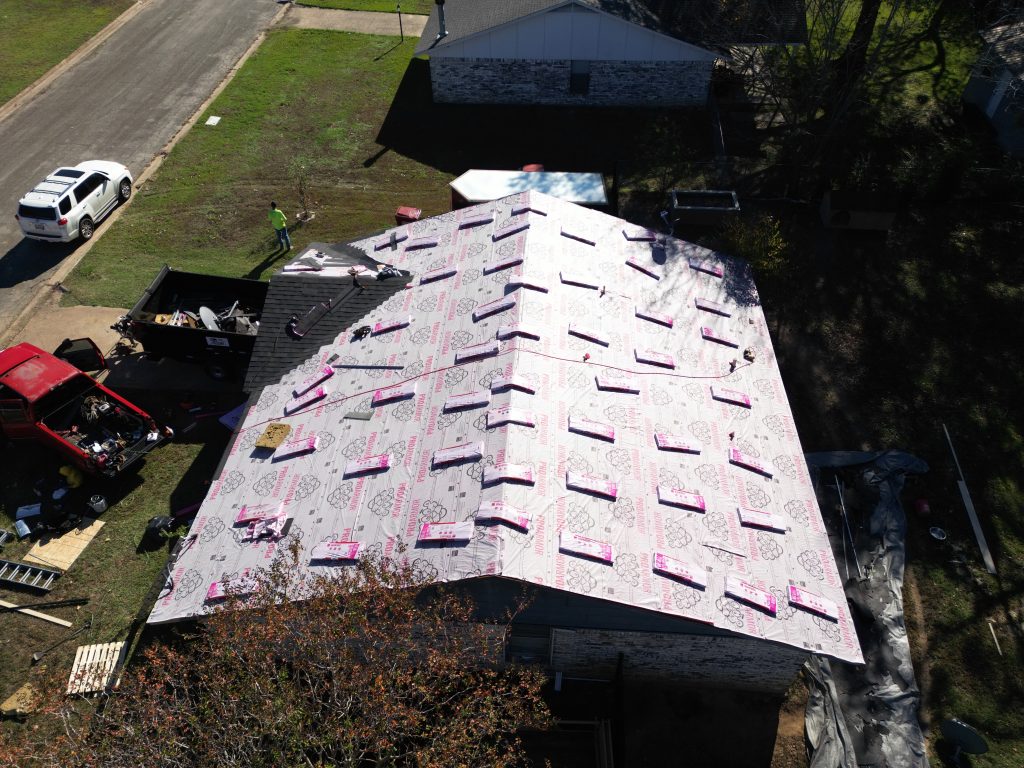
Synthetic underlayment down over fresh decking partway through a replacement

No. Nearly everyone stays home. It is loud, and vibration can shake picture frames on upper walls, so taking those down is worth doing. Park away from the house if you can, because that keeps your vehicle clear of the work and gives the crew room.

The tear-off goes straight into a dumpster we bring, not onto your lawn. At the end we run magnets across the drive, the grass and the flower beds. Nails are the single most common complaint homeowners have after a roof, so it gets done carefully and more than once.
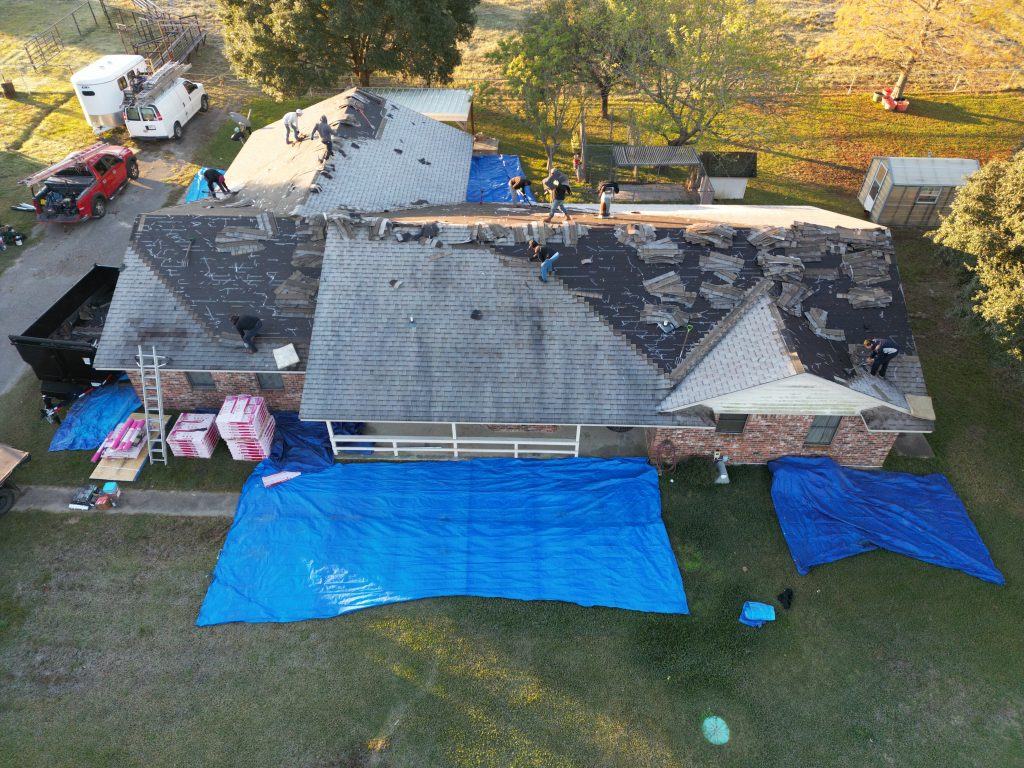
Tarps laid over the landscaping while an old roof is torn off

It is found once the old roof is off, which is the only time anyone can see it. We photograph it, show you, and tell you the cost before replacing anything. Decking is priced per sheet and it is listed on the written estimate as a possible extra, so it is never a surprise line on a final bill.

Rotten roof decking exposed around a vent pipe during a tear-off

Spring and fall are the most comfortable, but we replace roofs year round in Northeast Texas. Shingles need warmth to seal down properly, so in a cold snap the self-seal strip can take longer to bond. That is a timing consideration, not a reason to leave a failing roof through a winter.

ROOF REPAIRS

Roof repair questions

The repair part of this roofing FAQ matters, because a repair is often the right answer and we would rather do one that holds than sell a roof that was not needed yet.

Usually, yes. Most leaks are not the field of the roof failing. They are flashing at a chimney or a wall, a pipe boot that has split, a valley, or a nail that backed out. Those are repairs. We find the actual source rather than sealing the nearest suspicious spot, because water often enters well uphill of where it shows up on a ceiling.

Usually within a day or two, and faster when it is actively coming through a ceiling. Our shop is on Como St S in Sulphur Springs, so most of our area is a short drive. After a widespread storm the queue is longer for everyone, and we will give you a straight answer about where you are in it.

A properly made repair on a roof with life left should last for the remaining life of the roof. If a roof is near the end, a repair buys time rather than solving anything, and we will tell you that is what you are buying so you can plan.

We get as close as the manufacturer still makes. Shingle colors are discontinued and weathering changes the shade of what is already up there, so an exact match on an older roof is rare. On a visible slope we will talk through the options before doing the work.

Sometimes. If the roof has a few years left and the damage is contained, a repair is far less expensive than a replacement and there is no reason to spend more. We will give you the honest remaining life we see and let you decide.

No. The inspection is free, you get the photographs whether or not you hire us, and there is no obligation attached to it.

Most roof repairs in Northeast Texas run about $300 to $1,500: a cracked pipe boot, a few lifted shingles or a short run of flashing. Repairs that reach the decking, a valley or several areas of the roof run about $1,500 to $5,000 or more. These are typical ranges, not a quote, and you get a written price after a free inspection before any work starts.

STORM DAMAGE & INSURANCE

Storm damage and insurance claims

Northeast Texas gets real hail and real wind. This is the part of the roofing FAQ people read after a storm. It covers how a claim actually works and what a roofing contractor can and cannot do inside it.

Most policies cover sudden storm damage such as hail and wind. What varies is your deductible, whether the policy pays replacement cost or actual cash value, and any separate wind and hail deductible. Your carrier decides coverage. What we provide is a documented, photographed record of what is on the roof so the decision is made on evidence. The Texas Department of Insurance publishes a plain-English guide to all of this on its storm resource page.

On asphalt, a bruise: a dark circular spot where granules have been knocked away and the mat beneath is exposed and soft to the touch. Fresh hits often have a shiny look. On metal it is usually denting, which is often cosmetic. Soft metal is the giveaway from the ground, so check gutters, downspouts, vents and any aluminum trim.

It depends on the policy, and the clock generally runs from the date the damage happened rather than the date you noticed a stain on a ceiling. That is why a dated storm record matters, and why it is worth getting a roof looked at after a bad storm even if nothing is leaking yet.

We document the damage, prepare factual scope information and meet the adjuster on the roof so everyone is looking at the same thing. Negotiating or settling a claim on your behalf is the work of a public insurance adjuster, which is a separate role the state regulates, so that part stays between you and your carrier.

No, and nobody in Texas can. A contractor paying, waiving, rebating or absorbing any part of a deductible is prohibited under state law. The deductible is your share of the claim and it is the same figure whoever does the work.

It happens, and it is not the end of the road. You can ask your carrier for a reinspection, and the photographs and measurements from our inspection are yours to use in that conversation. We will not tell you in advance what a carrier will approve, because that is not ours to promise.

COST & ESTIMATES

What it costs, and how estimates work

The money section of our roofing FAQ: straight figures and what actually moves them. Every price in this roofing FAQ is a typical Northeast Texas range, not a quote. Every estimate we write is set out, and you keep it whether or not you use us.

For an average single-story home, an asphalt shingle replacement generally runs $6,000 to $14,000 including tear-off and disposal: about $8,000 to $14,000 for architectural shingles and $10,000 to $17,000 for Class 4 impact-resistant shingles. Metal runs $12,000 to $30,000 and up depending on the system. The spread is wide because roof size, pitch, the number of penetrations and the condition of the decking all move it. These are typical ranges, not a quote, and our roof replacement cost guide sets them out by home size.

Usually because they are not the same roof. Check whether each one includes tear-off and disposal, new underlayment, new pipe boots and flashing rather than reusing the old ones, a starter course, ridge ventilation and the shingle line by name. A written estimate lets you compare the parts instead of comparing two lump sums.

Yes. We go up on the roof, photograph what we find, and put a written estimate in your hands. There is no charge and no obligation, and the photographs are yours to keep.

For a straightforward replacement it is typically a deposit at the start and the balance on completion, set out in the signed agreement before anything begins. On an insurance job the timing follows how your carrier releases funds, which we will walk you through.

It protects value more than it adds it. A sound, recent roof removes an objection at sale and can affect what a buyer is willing to finance. A roof at the end of its life usually comes up in negotiation as a price reduction.

The estimate lists it in writing: tear-off and disposal, underlayment, the shingle or panel by name, starter and ridge, flashing and boots, ventilation, and cleanup. Decking replacement is priced per sheet and shown as a possible extra, because nobody can see the decking until the old roof is off.

For a single-story 2,200 sq ft home in Northeast Texas, a new architectural shingle roof typically runs about $12,000 to $18,000 installed, including tear-off and disposal. A two-story home of the same size has less roof, so it usually costs less. Pitch, the number of layers coming off and any soft decking move the number either way. These are typical ranges, not a quote, and the real figure comes from measuring the roof at a free inspection.

For a standard asphalt shingle roof on an average single-story home here, $30,000 is well above the usual range of $6,000 to $14,000, and even a 3,000 sq ft home typically lands between $16,000 and $24,000. It is a normal figure for standing seam metal, which runs about $18,000 to $30,000 and up, or for a very large, steep or complex roof with two layers to remove or a lot of decking to replace. If a quote surprises you, ask which of those is driving it. These are typical ranges, not a quote.

The roofing material and the labor to install it are the two biggest parts of the bill, and both grow with the size of the roof, measured in squares of 100 sq ft. The cost homeowners rarely see coming is decking: rotten or soft plywood only shows once the old roof is off, and it has to be replaced before the new roof goes on. We price decking per sheet, so you know the rate before any work starts.

The 25% rule comes from Florida’s building code, where repairing or replacing more than 25% of a roof within 12 months can require the whole roof to be brought up to current code. Texas has no statewide version of it. Here, whether a roof is repaired or replaced comes down to its condition, any permit rules in your city or county, and, on a storm claim, what your insurance company decides under your policy.

MATERIALS & BRANDS

Materials, brands and impact ratings

What we install, and the product facts this roofing FAQ is most careful about. Impact rating in particular is something a homeowner acts on with their insurer, and every lifespan in the roofing FAQ assumes a roof that was installed and ventilated properly.

Six: Owens Corning, CertainTeed, GAF, TAMKO, Malarkey and Atlas. We are an Owens Corning Preferred Contractor. Which line makes sense depends on your budget, whether you want an impact-rated shingle and what color range you are after.

Class 4 is the top result under UL 2218, an impact test where a steel ball is dropped on the shingle and the mat is checked for cracking. It is the rating insurers look for, and the National Roofing Contractors Association is a neutral starting point on roofing standards. Class 4 lines include Owens Corning Duration STORM, CertainTeed NorthGate, GAF Timberline UHDZ and Timberline AS II, TAMKO StormFighter FLEX, Malarkey Legacy and Atlas StormMaster and Pinnacle Impact.

No. Timberline HDZ is an excellent architectural shingle and it is widely installed, but it is not UL 2218 Class 4. Within the same family, Timberline UHDZ and Timberline AS II are. It is worth being precise here, because the difference can matter to an insurer. TAMKO Titan XT is likewise Class 3 rather than Class 4; their Class 4 line is StormFighter FLEX.

In hail country it often is. Many Texas carriers offer a premium credit for an impact-rated roof, and over a roof lifetime that can offset a good part of the difference. The credit varies by carrier so ask yours for your own number rather than trusting a figure off a website. The practical benefit is a mat that resists cracking under impact, rather than a roof hail leaves alone.

A 3-tab is a single flat layer with cutouts. An architectural shingle is laminated, with a second layer built up to create shadow lines and more thickness. Architectural shingles carry longer warranties and higher wind ratings and are what we install on nearly every home now.
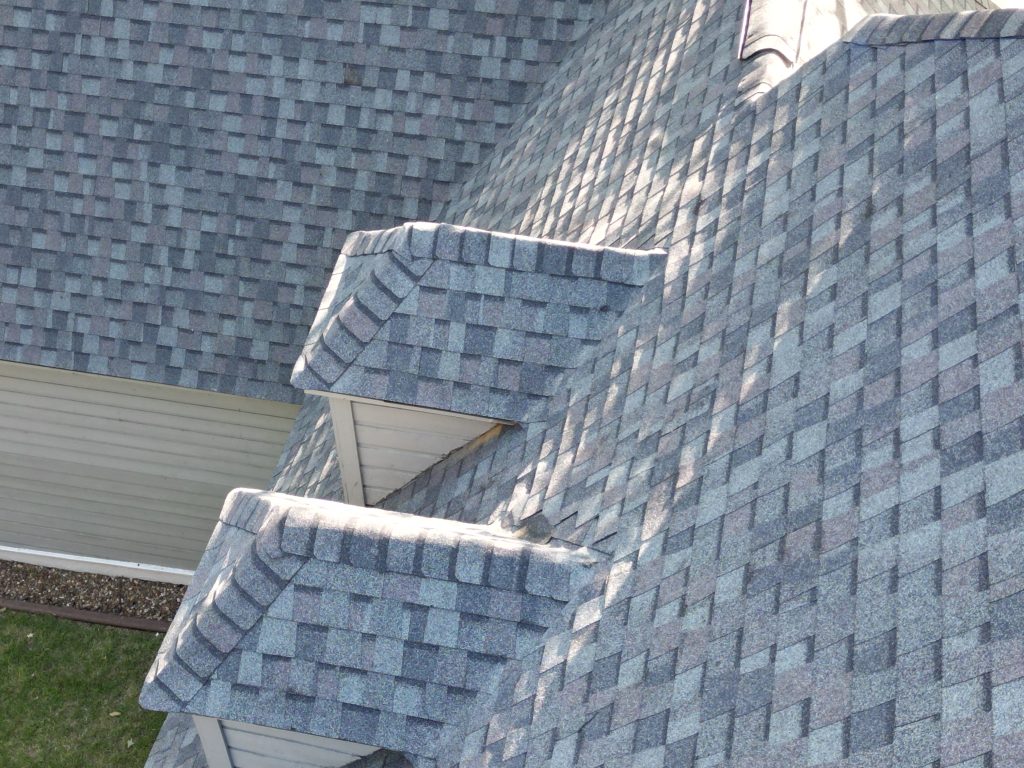
Close view of an architectural shingle roof showing its layered shadow lines

Asphalt shingles, standing seam and exposed-fastener metal, TPO and modified bitumen for low-slope commercial work, and seamless gutters. For anything outside that we would rather point you to someone who specializes in it than learn on your house.

With good installation and basic upkeep, 3-tab asphalt shingles usually last 15 to 20 years in Texas, architectural shingles 22 to 30, Class 4 impact-resistant shingles 25 to 30, and standing seam metal 40 to 70. In Northeast Texas, hail and summer heat shorten those numbers more than age does, so a roof that has taken a hard hailstorm can need attention well before its age suggests.

METAL ROOFING

Metal roofing questions

Metal is the longest-lived roof we install, and the metal part of the roofing FAQ is usually the same five.

A properly installed standing seam roof commonly runs 40 to 70 years in Texas. Exposed-fastener panel is shorter, generally 30 to 45 years, and the limiting factor is usually the fasteners and their washers rather than the panel itself.

Not the way people expect. A metal roof over solid decking and underlayment, which is how we install it on a house, sounds close to any other roof from inside. The drumming people remember is bare panel over open purlins on a barn or a carport.

Standing seam hides its fasteners under the seam, so nothing penetrates the weather surface. Hail on it is usually cosmetic denting rather than a leak path. Exposed-fastener panel is screwed through the face, which is quicker and less expensive, but those screws and their rubber washers age and can back out over time, and each one is a place water could eventually get in.

Sometimes it is physically possible, but we generally tear off first. Going over an old roof hides whatever is wrong with the decking, and decking is the one thing you want to see and fix while it is accessible. It can also affect the manufacturer warranty.

A reflective metal roof reflects more solar energy than a dark asphalt roof, so it can reduce heat gain into the attic. How much you notice depends far more on your attic insulation and ventilation than on the roof surface, which is why we look at the whole system rather than quoting a saving.

No. Metal does not attract lightning. It is non-combustible, which is the more useful property.

COMMERCIAL & AGRICULTURAL

Commercial, shop and barn roofing

This part of the roofing FAQ covers low-slope commercial work and metal buildings, a different system from a house, with different failure points.

Usually TPO, a single-ply membrane that is heat-welded at the seams, or modified bitumen. Both are built for water that sits and moves slowly rather than water that runs straight off. Shingles are not an option below a certain pitch, whatever the budget.

A well-installed TPO roof commonly runs 20 to 30 years and metal considerably longer. Drainage is the thing that decides it. Standing water and blocked drains age a low-slope roof faster than weather does.

Seams, penetrations and drainage, in that order. Anything that comes through the roof is a detail that was flashed by hand, and hand details are where water finds a way in. That is why an annual look at a low-slope roof is worth far more than it costs.

Yes, and a lot of our work is exactly that. Exposed-fastener panel over purlins is the common system, and the usual job on an older building is backing out and replacing aging fasteners and washers before they turn into leaks.

Often, yes. A membrane roof with sound insulation underneath and a handful of failed seams is a repair. Once water has been getting into the insulation for years, patching the surface does not fix what is already wet underneath, and we will show you the difference.

Yes. On an occupied building we plan access, noise and debris around your hours, and we keep entries and parking usable. That gets agreed before the job starts rather than on the morning.

WORKING WITH DJJ

Working with DJJ Roofing

The last section of the roofing FAQ: who we are, what is covered afterwards, and how to get on the schedule. If the roofing FAQ has not covered your question, the phone number is the fastest way to an answer.

Our core area is Hopkins, Hunt, Franklin, Delta and Wood counties, and we regularly work Titus, Lamar, Rains, Van Zandt, Collin and Rockwall as well. The shop is at 124 Como St S in Sulphur Springs, so most of that is a short drive rather than a dispatch from another city.

Two separate things. The manufacturer warrants the materials, and the length depends on the shingle or panel line you choose. We warrant our workmanship for 10 years, which covers the installation itself. Both are explained before you sign, and we will help you register the manufacturer warranty.

The common ones are work done later by someone else that disturbs the roof, satellite dishes or solar brackets fixed through it without proper flashing, pressure washing, and ventilation that does not meet the manufacturer requirement. Ask us before anything gets mounted on a new roof.

Our own crew. DJJ Roofing is family owned and has worked out of Sulphur Springs since 2015, and the people who quote the job are the people you deal with through it.

Monday to Saturday, 8:00am to 6:00pm. Calls outside those hours reach voicemail and we return them the next working morning.

Call (903) 217-5431 or send the form on any page of this site. Tell us the town and roughly what you are seeing, and we will set a time. You get photographs of whatever we find and a written estimate, at no cost and with nothing attached to it.

STILL STUCK

A question this roofing FAQ did not answer?

Call and ask. You will get somebody who works here rather than a call center, and you are not committing to anything by asking. A roofing FAQ can only go so far, and some answers need eyes on the roof. If yours does, we will come and look, photograph what is there and put it in writing, at no cost. More detail on how a claim works is on our insurance claims page, and the roofing terminology page explains the words an adjuster or an estimate will use.

Get the roof looked at, then decide.

Free, photographed, and written down. If the roofing FAQ above did not settle it, a look at the actual roof will. Mon to Sat, 8:00am to 6:00pm.