Gutter cleaning: the smallest job we do, and the one that prevents the most damage.
Gutter cleaning across Northeast Texas: runs and downspouts cleared, the system flushed, discharge checked, and anything else we notice from up there photographed and reported at no extra charge.

Gutter cleaning in plain terms
Gutter cleaning is unglamorous and it is genuinely the best value work in this trade. A blocked gutter does not fail dramatically. It overflows in the same place every storm, soaks the fascia behind it, sends water behind the drip edge into the decking, and saturates the ground against the foundation. Two or three years of that produces rotten fascia, soft sheathing at the eaves, and in clay soil, foundation movement, none of which anybody blames on a gutter.

The mechanism gutter cleaning prevents is simple. Debris collects at the low points and at the outlets, water backs up, and the run stops working as a channel and starts working as a trough. On a saturated run the weight pulls hangers out of the fascia, which makes the fall wrong, which makes it hold more water. It is a self-accelerating problem and it is entirely preventable with an hour of somebody’s time once or twice a year.
How often depends almost entirely on what is growing above the roof. A house with nothing overhanging might need gutter cleaning once a year. A house under oaks needs it twice. A house under pines needs it twice and will fill faster than either, because needles pack into a dense mat rather than floating on top of the water the way leaves do. The older neighborhoods here with mature trees directly over the rooflines are the ones that need a rhythm.
What our gutter cleaning actually involves is more than scooping the runs. Debris out by hand, downspouts checked and cleared through, which is where most real blockages are, the system flushed with water and watched, hangers and fall checked, and the discharge points looked at to see where water is actually going once it leaves the roof. That last one is the item that most often needs attention and almost never gets it.
There is a timing point worth making, because it changes the outcome. The right time is after the leaves are down and before the winter rains start, and the wrong time is after the first heavy storm has already backed water up behind the drip edge. Going into a wet season with clear runs and working downspouts prevents a meaningful share of the January leak calls we get, many of which are not roof failures at all but water that had nowhere to go and found its way behind the eaves instead.
The other genuine value is what somebody notices from up there. A gutter cleaning visit puts a roofer at eye level with the fascia, the drip edge, the lower courses of shingle and the vent boots on the lower slopes. A surprising share of the problems we catch early are found on gutter cleaning visits rather than on inspections, simply because we were already there and looking.
Everything below is in the gutter cleaning price we quote you
Runs Cleared By Hand
Debris removed rather than pushed along, and taken away rather than left in the beds.
Downspouts Cleared Through
Where most real blockages sit. Checked and cleared until they run properly.
System Flushed And Watched
Water run through and observed at the outlets and discharge points, not just poured in and assumed.
Hangers And Fall Checked
Sagging sections, loose hangers, and runs holding standing water identified and reported.
Discharge Assessed
Where water actually goes once it leaves the downspout, which is the most commonly neglected part of the system.
Photographed Report
What we cleared, what we noticed, and anything worth doing, with images, at no charge for the observation.
Start to finish, in order
Book It In
Autumn is the natural time, and spring after the pollen and seed drop. Phone or use the form.
Clear By Hand
Runs and corners emptied, and the debris bagged and removed rather than left on the ground.
Downspouts
Checked and cleared through, from the outlet all the way down to the discharge point.
Flush And Observe
Water through the system while we watch the outlets and the discharge points under load.
Report
A short written note with photographs: what was cleared, what we noticed, and what if anything is worth doing.
Four things we do on every single job
Photographs, Not Opinions
Every problem area is photographed and shown to you before anybody quotes a price. You keep the images whatever you decide.
In Writing
The estimate names the products going on your roof, so you can compare it against anybody else’s.
Cleaned Up Daily
Beds and shrubs covered before work starts, and a magnet over the yard and driveway at the end of every working day.
A Local Phone Number
Our shop is on Como St S in Sulphur Springs. The company that fits your roof is the one you call in year four.
“Highly recommend DJJ Roofing LLC! They were professional, timely, and did an excellent job on our roof. The quality of work and customer service were top-notch. Will definitely use them again for any future roofing needs!”

What a blocked gutter actually costs
The foundation is the expensive one, and it is the strongest argument for gutter cleaning in this region rather than a theoretical concern. The expansive clay soils across Hopkins and Hunt counties swell when saturated and shrink as they dry, and repeatedly dumping water at one corner of a slab produces exactly the localized, cyclical moisture change that clay responds to worst. Texas A&M AgriLife Extension publishes guidance on managing moisture around foundations in these soils, and foundation movement is an order of magnitude more expensive than any gutter work.
The roof edge is the hidden one. When a run overflows or backs up, water goes behind the drip edge into the fascia and the ends of the decking. There is no ceiling stain and nothing visible from inside, which is why we routinely find soft sheathing along the eaves on houses whose gutters have been overflowing for a couple of seasons. By the time it shows, it is a repair rather than a clean.
Then everything at ground level: fascia rot, soffit staining, siding splashed with mud, beds eroded, walkways undermined, and in the worst cases water finding a crawl space. Individually minor, cumulatively expensive, and all of it downstream of a job that costs less than almost anything else on a house.

Signs your gutters need clearing
Any one of these is worth a look, and most of them are visible from the ground during the next heavy shower.
Water sheeting over the front edge of the gutter in ordinary rain rather than running to the outlets.
Plants or grass growing out of the run, which is unambiguous.
Silt or standing water visible in the gutter days after rain.
Downspouts that barely trickle during heavy rain while the run above overflows.
Staining or streaking down the fascia and siding beneath the gutter line.
Sagging between hangers, which usually means the run has been holding weight for a while.
What we can do while we are there
Four things, and the first is the standard visit. The other three only get quoted where they are genuinely warranted.
Clear And Flush
The standard gutter cleaning visit: runs, corners and downspouts cleared, the system flushed and watched, and discharge checked.
Reset Hangers And Fall
Sagging sections re-hung with hidden hangers and correct fall, rather than left to keep holding water.
Add Downspouts
Where a long run overflows at one end, an extra outlet is usually the actual fix rather than more frequent clearing.
Guards And Extensions
Guards under trees to reduce clearing frequency, and extensions to get discharge properly away from the slab.

No guard system removes maintenance entirely, because fine debris still passes through any mesh. Less often is the honest description, and it is still a worthwhile improvement on a house under pines.
Guards, and being honest about what they do
Guards are a legitimate product that solves a real problem on some houses and are unnecessary on others, so it is worth understanding what they actually achieve before spending several thousand dollars on a system.
They genuinely help, and they do not eliminate maintenance. A mesh or screen system keeps leaves out effectively. What still gets through is fine material, meaning grit, shingle granules, pine needle fragments and seed, and it accumulates into a layer that eventually needs clearing, just considerably less often.
Where they are clearly worth it is under trees, and especially under pines. A house that currently needs gutter cleaning twice a year with a real risk of blockage between visits becomes a house that needs a look once a year. That is a genuine improvement in both cost and risk. On a house with no overhanging trees, guards solve a problem you do not have. We fit them where they make sense and tell you plainly what they will and will not do.
Discharge: the two minutes that protect a foundation
Everything else on this page is about gutter cleaning: getting water off the roof and into the gutter. This is about the part almost nobody thinks about: what happens to it after that. It is the least expensive thing on this entire website to put right, it needs no specialist equipment, and in a region built on expansive clay it protects the single most expensive component of your house.
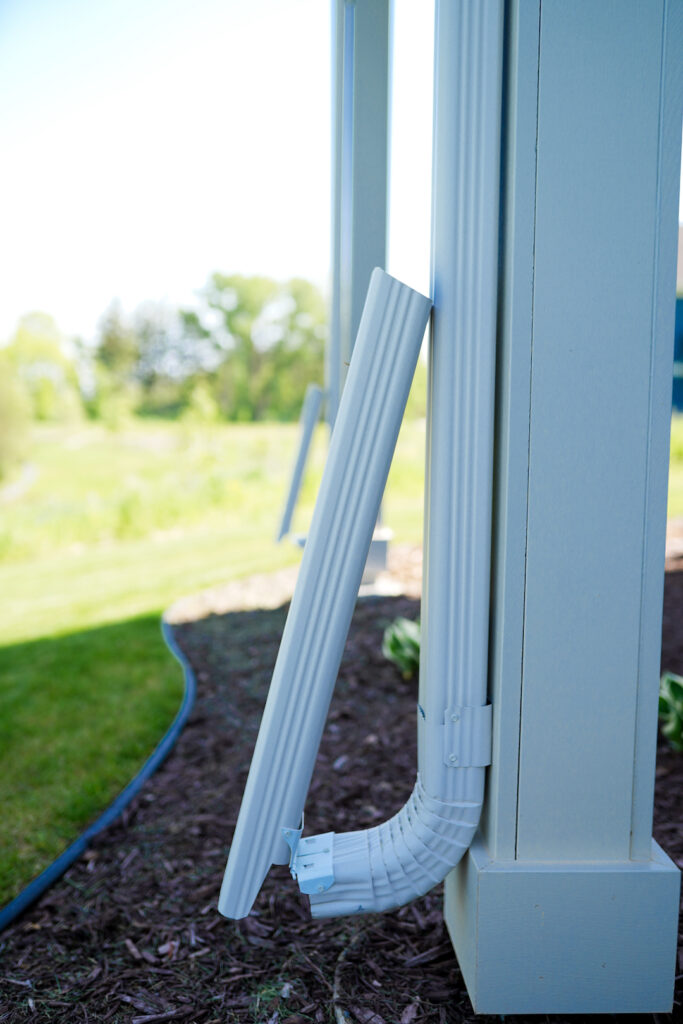
The most neglected part of any gutter system is the last three feet of it. Downspouts get knocked out of place by mowers, extensions get moved for a job and never put back, splash blocks disappear under mulch over a couple of seasons, and underground drains block silently. All of it ends with water discharging at the base of the wall, which is precisely the thing the entire system exists to prevent.
The target is simple: get water four to six feet away from the foundation, onto something that carries or spreads it rather than letting it pool. Extensions and splash blocks are inexpensive and they are the single highest-return item on a house in clay soil. We check discharge on every visit and tell you where it needs moving, because a perfectly clean gutter emptying eight inches from the slab has relocated the problem rather than solved it.
The homeowner version of this takes two minutes and costs nothing: walk around the house during heavy rain and look at where water is actually going. Not afterwards, but during, when the system is under load. You will see immediately which run is overflowing, which downspout is not running, and where the discharge is landing. It is the most useful thing anybody can do for their own roof and foundation without spending a penny.
Straight answers, free of charge
The inspection, the photographs and the written estimate cost nothing and commit you to nothing. If the honest answer is that the work can wait, that is what the estimate will say.
What a gutter cleaning visit depends on
Linear Footage
The total length of gutter cleaning run to be cleared, measured rather than guessed at.
Height And Access
Two-story runs and awkward access take longer and need more setup than a single-story fascia.
Debris Load
A run under pines that has not been touched in three years is a different job to an annual clean.
Number Of Downspouts
Each one gets checked and cleared through, and that is where the real blockages usually are.
Repairs Found
Re-hanging, additional outlets or fascia work quoted separately, and only where genuinely needed.
Guards Or Extensions
Optional, set out, and recommended where the trees or the discharge points actually warrant them.
Four gutter maintenance mistakes
Clearing The Runs But Not The Downspouts
The outlet is where blockages sit. A clean run feeding a blocked downspout still overflows.
Doing It Off A Ladder Yourself
Ladder falls while cleaning gutters are one of the most common serious home-maintenance injuries there is.
Ignoring Where The Water Lands
A spotless gutter emptying at the slab has moved the problem rather than fixed it, especially in clay soil.
Expecting Guards To End Maintenance
Fine debris still gets through any mesh. Less often is the honest expectation to have of them.
Gutters and the seasons here
The gutter cleaning rhythm in Northeast Texas is autumn leaf drop and spring pollen and seed, and the houses that need attention most are in the older neighborhoods where mature oaks and pines sit directly over the rooflines. Those are twice-a-year houses, and the pines are the reason, because needles pack into a dense mat that water cannot pass in a way leaves never quite manage.
The rainfall pattern is the other half of it. We do not get gentle all-day drizzle here. We get short violent storms that deliver an inch or two in an hour, and a gutter that copes fine with light rain will overflow in one of those if it is even partly blocked. That is why the useful test is watching the system during a real storm rather than looking at it on a dry afternoon.
There is also a straightforward relationship between gutter maintenance and roof life that gets overlooked. Every one of the eave-line decking repairs we do on a re-roof, meaning soft sheathing at the bottom courses, rotten fascia and drip edge corroded through, started as water going somewhere it should not have. Those are the repairs that show up as unexpected estimate items on a roofing estimate, and a great many of them trace back to a gutter that overflowed for a few seasons. The National Roofing Contractors Association sets out the drip edge and eave detailing that assumes a gutter is doing its job.
Clay soil makes the discharge question locally important rather than merely tidy. The expansive soils here respond badly to cyclical wetting at the slab edge, and that is exactly what a displaced downspout produces. Getting discharge properly away from the foundation is the least expensive thing on this entire website and one of the most consequential. If you are replacing guttering rather than clearing it, our seamless gutters page covers that side of it.

Questions about gutter cleaning
It depends almost entirely on what is growing above the roof. A house with nothing overhanging is usually fine once a year. Under oaks it is twice. Under pines it is twice and they fill faster, because needles pack into a mat that water cannot pass through rather than floating on top the way leaves do.
After the leaves are down and before the winter rains start. The wrong time is after the first heavy storm has already backed water up behind the drip edge. Spring is worth a second visit in this region because of pollen and seed drop.
You can, and the reason we would rather you did not is that ladder falls while cleaning gutters are one of the most common serious home-maintenance injuries there is. If you do go up, have somebody foot the ladder, and never lean sideways to reach the next section. The two-minute version that is genuinely safe is walking around the house during heavy rain and watching where the water goes.
Under trees, and especially under pines, yes. They will not end maintenance, because fine grit, granules and needle fragments still pass through any mesh and build into a layer over time. What they do is turn a twice-a-year job with a real risk of blockage in between into a once-a-year look. On a house with nothing overhanging they solve a problem you do not have.
Almost always the discharge rather than the gutter. Downspouts get knocked out of place, extensions get moved and not put back, and splash blocks disappear under mulch. The aim is to get water four to six feet from the foundation, which in the clay soils here matters a great deal more than it sounds like it should.
Other services
Flashing failures, lifted shingles and wind damage put right before water gets in.
Five and six inch seamless aluminum, fabricated on site to fit your roofline.
Let’s get somebody up there to look.
Fill out the form or pick up the phone. Either way you get straight answers about your roof and a written estimate you can keep.