Commercial Roofing in Cooper, TX
We handle commercial roofing in Cooper and across Delta County from a single yard on Como Street South. Cooper is half an hour north of the shop, one of the closer towns we cover outside Hopkins County. Every job starts with somebody on the roof taking pictures, and every price is written down before a shingle moves.
- TPO, modified bitumen and low-slope systems
- Scheduled around your trading hours
- Free assessment and written scope
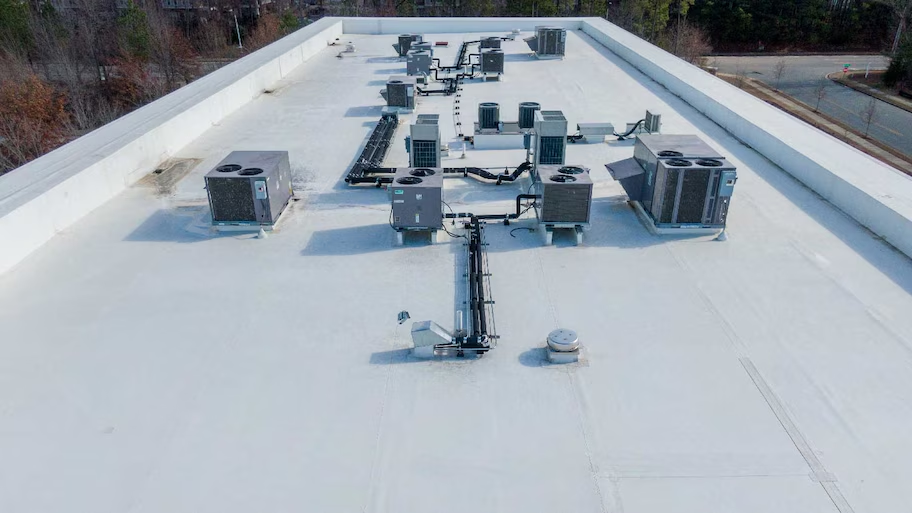
Commercial roofing for Cooper businesses
Low-slope roofs fail differently from houses. Water sits rather than running off, which shifts what matters onto seams, terminations, drainage and every detail around what comes through the deck.
All of it is covered by the written estimate for commercial roofing in Cooper before any work starts. If something turns up once we are on the roof, you see a photograph of it and decide what to do, rather than finding it as a line on an invoice afterwards.
TPO and single-ply
Heat-welded seams, mechanically attached or fully adhered. The reflective surface keeps a Cooper building cooler through a Texas summer, which shows up on cooling costs. This is what the written estimate for a Cooper job covers before anything begins.
Planned maintenance
Twice-yearly inspections with photographs, so a building owner is replacing sealant at year eight rather than a membrane at year fourteen. Every Cooper property we work on gets this as part of the job.
Roof-mounted equipment
Curbs, sleepers and walkway pads around units that get serviced. Foot traffic on a low-slope roof does real damage when there is nothing protecting the membrane. This is what the written estimate for a Cooper job covers before anything begins.

The building stock around Cooper
Cooper is the Delta County seat and sits in farmland between the forks of the Sulphur River. The roof stock is weighted toward older homes, a good number of them farmhouses that have been re-roofed more than once, plus working agricultural buildings running exposed-fastener metal.
We keep a separate page for Cooper rather than one page for the whole region because the answers genuinely differ. Roof age, pitch, material and exposure all change what the right job is, and a general page cannot say anything useful about any of them.
Cooper is half an hour north of the shop, one of the closer towns we cover outside Hopkins County. There is more about the area on the Cooper page, and more about the work on the Commercial Roofing page.
The short version is that we are close enough to Cooper to be useful and small enough to care whether the job was right. Both of those matter more in year three than they do on the day.
The three things Cooper roofs take
Delta County is open farmland, which means wind reaches a roof with almost nothing in the way, and the county takes the same spring hail as the rest of Northeast Texas. That combination is why we photograph every slope rather than the one you asked about. Damage around Cooper is very often on a single elevation.
All three are gradual, and all three are visible to somebody standing on the roof long before they are visible from the yard. That gap is the reason an inspection is worth having before you need commercial roofing in Cooper rather than after.
All of it feeds into what commercial roofing in Cooper actually has to address.
Storm season
Most of the roof damage we document around Cooper happens in a handful of spring storms. The rest of the year is mainly heat and time.
Heat and attic temperature
An attic that runs hot through a Delta County summer ages the shingle above it from the underside, where nobody is looking.
Water that does not leave
Blocked gutters and flat spots hold water against the roof edge long after the rain has stopped. That is a slow failure rather than a sudden one.
What the roofs around Cooper are actually like
Older farmhouses and in-town housing, plus the working buildings that go with farmland: equipment sheds, shops and barns, nearly all metal. Full replacements are a larger share of what we do in Cooper than in newer towns, because a good deal of the housing is old enough to be on its second or third roof.
Spring hail sets the pace, as it does across the region, and the agricultural side adds its own rhythm: work on sheds and barns gets scheduled around what the farm is doing rather than around the weather.
What we get called for
Full replacements more often than repairs. On a farmhouse roof that has been covered twice already, the interesting question is what the decking is doing, and a tear-off in Cooper turns up sheets needing attention more often than it does on newer stock.
What people choose
Metal does most of the work on the agricultural buildings and it is the right product there, provided somebody checks the fasteners every few years. On the houses, architectural shingle over a properly repaired deck is usually better value than spending on the surface while leaving what is under it.
Who calls us here
Homeowners and farm owners in roughly equal measure, and a good share of the work arrives through somebody who already knows a job we have done nearby.
Almost never in the middle of the field
On a commercial building in Delta County the membrane itself is rarely the problem. The failures cluster at the edges and around anything that penetrates the deck.
This is why our inspection covers the whole roof rather than the one slope you asked about. Around Cooper it is common for the problem you noticed and the problem that matters to be on different elevations.
Standing water
Low-slope is not no-slope. Where positive drainage was never established, water sits after every storm and works at the seams continuously. A frequent finding on the properties we inspect around Cooper.
Penetrations and curbs
Every unit, vent and conduit through the deck is a place the membrane has been cut and sealed back. Those seals age faster than the field. It accounts for a real share of the Cooper roofs we are called to.
Expansion joints
Where a building is designed to move. A joint detailed as though it were static will tear. It accounts for a real share of the Cooper roofs we are called to.
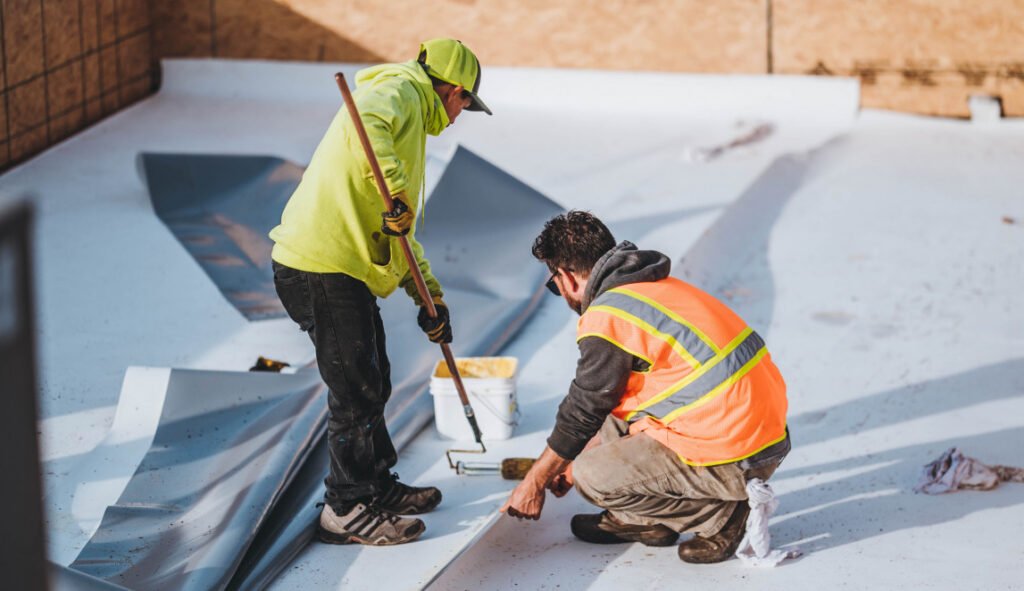
How a commercial job runs in Cooper
Commercial work is scheduled around a business rather than the other way round. The sequence does not change; the timing is yours.
The whole sequence normally runs from your first call to a finished roof inside two weeks for a Cooper address, and faster where there is an active leak. Weather is the only thing that regularly moves a date.
Assessment
We walk the roof, photograph every penetration and termination, and check the drainage pattern after rain where we can. It applies whether the Cooper job takes an hour or a full day.
Written scope
What has failed, what we propose and what it costs, set out so an owner or a board can read it without translation. This does not change from one Delta County job to the next.
Scheduling
Around your trading hours where the work allows it. Most Cooper businesses do not need to close for roofing work. It applies whether the Cooper job takes an hour or a full day.
Installation
Staged so the building stays watertight overnight at every point in the job, whatever the forecast does. It applies whether the Cooper job takes an hour or a full day.
Handover
Photographs of the finished detail work, and a walk of the roof with whoever maintains the building. It happens on every Cooper job regardless of size.
Six signs a Cooper commercial roof needs attention
Low-slope roofs do give warning, and the warning usually appears inside the building before it appears on top of it. These are the ones worth acting on.
If you can see one of these from the ground at a Cooper address, it is worth having somebody look properly. Most of them are inexpensive to deal with early and expensive to leave.
Ceiling tiles staining
The classic first sign in a commercial building. By the time a tile stains, water has been tracking along the deck for a while. This is one of the more frequent findings on a Delta County roof.
Ponding that lasts past two days
Low-slope is not no-slope. Water still sitting forty-eight hours after rain means drainage has failed somewhere. It turns up often on older properties around Cooper.
Loose edge or parapet metal
Wind gets under a loose termination and peels inward. This is the failure mode that turns a repair into a replacement. We see this regularly at Cooper addresses, particularly after a wind event.
Fasteners showing through the membrane
Backed-out fasteners telegraphing through single-ply is a sign the deck attachment is working loose. It turns up often on older properties around Cooper.
Soft or spongy areas underfoot
Usually wet insulation rather than a soft deck, and it spreads well beyond where the water got in. It turns up often on older properties around Cooper.
Rust at a metal deck edge
On an older building this is structural rather than cosmetic and wants looking at properly. Worth a look from the ground at any Cooper address after a storm.
Which low-slope system suits the building
There is no single best commercial roof. There is one that suits the deck, the traffic and the budget of a particular Cooper building.
Any of these can be the right answer in Delta County. The wrong answer is the one chosen without anybody looking at the roof first, which is why the inspection comes before the recommendation rather than after it.
Worth reading elsewhere: the National Roofing Contractors Association publishes the low-slope standards this work is built to, and Owens Corning documents the commercial systems we install.
Repair and restoration
Not every commercial roof needs replacing. Where the field is sound, repairing the terminations and details buys real years for a fraction of the cost. Worth considering on most Cooper properties, and we will say when it is not.
Insulation and tapered systems
Where a roof has never drained properly, tapered insulation can build the fall in rather than leaving water sitting on a flat deck. It is a common choice across Delta County and we stock for it.
Coatings and restoration
On a sound but aging membrane, a coating system can add years for a fraction of a replacement. It is not right for every Cooper roof and we will say when it is not. Suited to a good number of the buildings around Cooper.
Tapered insulation
Where a roof has never drained properly, building the fall in with tapered insulation solves the cause rather than patching the symptom every few years. We install this regularly on Cooper properties.
What commercial roofing costs in Cooper
Commercial pricing is driven by square footage, system and access rather than by a simple per-home figure. These are the variables that actually move it.
The range is wide because Cooper properties are. The only honest way to narrow it for commercial roofing in Cooper is to get on the roof and measure it, which costs nothing and carries no obligation whatsoever.
Access and scheduling
A roof reached only by crane, or work restricted to nights and weekends, costs more than the same roof with open access during the day. It is assessed the same way on every Cooper job we quote.
Insulation and code
Where a replacement triggers current insulation requirements, that is a real cost and we will flag it at the assessment rather than after. The same method applies to every property we price in Delta County.
Deck repairs
Metal, concrete and wood decks each behave differently once the membrane is off. Priced per area rather than guessed at, and shown to you before anything covers it. You will see this reflected on a Cooper estimate.
A repair is often the right commercial answer
Where the membrane field is sound and the failures are at the details, repairing those details costs a fraction of replacement and buys real years. We will tell you which of those a Cooper roof is. See TPO roofing for more on the system we install most.
“Highly recommend DJJ Roofing LLC! They were professional, timely, and did an excellent job on our roof. The quality of work and customer service were top-notch. Will definitely use them again for any future roofing needs!”
 Verified on Facebook
Why Cooper property owners call us
Four things worth checking about whoever ends up on your Cooper roof. We hold all four and we are happy to evidence every one of them before you agree to anything.
Every one of those is verifiable before you commit to anything. Ask us for the certificate of insurance, read the reviews at the source rather than the ones we chose to reprint, and keep the written estimate somewhere safe once you have it.
Somebody local answers
Eliceo and Daniel handle the calls themselves. There is no call center between you and the people doing the work on your Cooper roof. That is how we have worked around Cooper from the start.
Scheduling in days
Cooper is half an hour north of the shop, one of the closer towns we cover outside Hopkins County. Most weeks we can have somebody at a Cooper address within a few days, and an active leak moves to the front of the queue. That has been true for every Cooper job since 2015.
A warranty that means something
Ten years on our workmanship, in writing, on top of whatever the manufacturer covers on the material itself. Two different things covering two different failures. No exceptions, on any Cooper address.
4.9 across 76 reviews
Published on Google and Facebook, unfiltered, and a good share of them from Delta County. You can read every one of them at the source. It holds on every job we take in Delta County.
Towns near Cooper
We cover the towns around Cooper on the same trips, so a job a few miles out is rarely a separate journey or a longer wait. Each one below has its own page with the local detail for that area, including what the roofs there have actually been through.
Other roofing work in Cooper
The other jobs we handle at Cooper addresses. If what you need is not commercial roofing, it is almost certainly on this list, and each one has a page of its own.
We keep a page per job per town rather than one page for everything because the honest answers differ. Roof age, pitch, material and exposure all change what the right work is at a Cooper address, and a page written for the whole region cannot say anything useful about any of them.
Questions we get about commercial roofing in Cooper
Almost never. Most commercial roofing in Cooper is done during trading hours without affecting the business underneath, and where noise is an issue we schedule around it. Thirty minutes south of Cooper, at our shop on Como Street South in Sulphur Springs.
For work that genuinely does need quiet hours, we can stage it in sections or start early. Most Cooper building owners find the roof is finished before it becomes a topic with their customers. The honest answer for any particular Cooper property depends on what is actually up there, which is what the free inspection establishes.
A properly installed and maintained TPO or modified bitumen roof commonly gives twenty years or more. What shortens it is almost always neglected detail work rather than the membrane wearing out in the field.
Twice-yearly inspections are what make the difference. Catching a lifting seam or a failed pitch pocket in year eight keeps a roof on course for twenty; finding it in year fourteen usually does not. We are happy to go through this in more detail for a Cooper roof, either on the phone or when we are out there.
Yes, and it is a normal part of low-slope work. Units, conduit and ductwork all have to be lifted, flashed around or reset, and the detail work around them is where most commercial roofs actually fail. We photograph every one of them before and after so there is a record of how each was left. If you want that answered for your own Cooper roof specifically, the inspection is free and we will put the answer in writing.
We will schedule recurring inspections with photographs, which is what most building owners actually want. Catching a lifting seam or a failed pitch pocket early is the difference between a sealant repair and a replacement, and on a commercial roof that gap is measured in tens of thousands. We are happy to go through this in more detail for a Cooper roof, either on the phone or when we are out there.
An active leak in a commercial building goes to the front of the queue, and getting it covered comes before diagnosing it properly. Our published hours are Monday to Saturday, and we would rather be straight about that than promise otherwise. If you want that answered for your own Cooper roof specifically, the inspection is free and we will put the answer in writing.
Book a free Cooper roof inspection
A few details is all we need to get a free inspection booked at your Cooper address. We will walk the roof, photograph what we find and put a price in writing, and none of that costs you anything.
Get Your Free Quote
Enter your details below and we will get back to you with a real number.
Start with a look at the roof.
We will walk the roof, photograph what we find and put a price in writing. What you do with it afterwards is entirely up to you, and the inspection costs nothing either way. If the roof turns out to have years left in it, that is what the report will say and there will be no invoice attached.
Ask us about commercial roofing in Cooper and we will tell you plainly what the roof needs.