The short version
- Curling, cupping or clawing shingles mean the mat is failing, not just the surface.
- Bare patches and granules collecting in the gutter are the roof shedding its UV protection.
- Daylight through the decking in the attic is the clearest signal there is.
- Sagging along a ridge or between rafters points at decking or structural moisture.
- Repeated repairs in different areas usually mean the roof as a whole is done.
- Age plus any two of these is generally the point to price a replacement rather than another patch.
Knowing the signs your roof needs to be replaced can save you thousands of dollars and a lot of stress, because the most expensive roof problems are the ones homeowners do not catch until water is already inside the house. In the Northeast Texas climate, where hail, heat, and humidity wear roofs down faster than the manufacturer’s ideal numbers, it pays to know what to look for. This guide covers the 10 clearest signs of a worn-out roof, how to tell replacement from a simple repair, and what to do next.
10 Signs Your Roof Needs to Be Replaced
If you notice several of these at once, your roof is likely telling you it is time for a replacement rather than another patch.
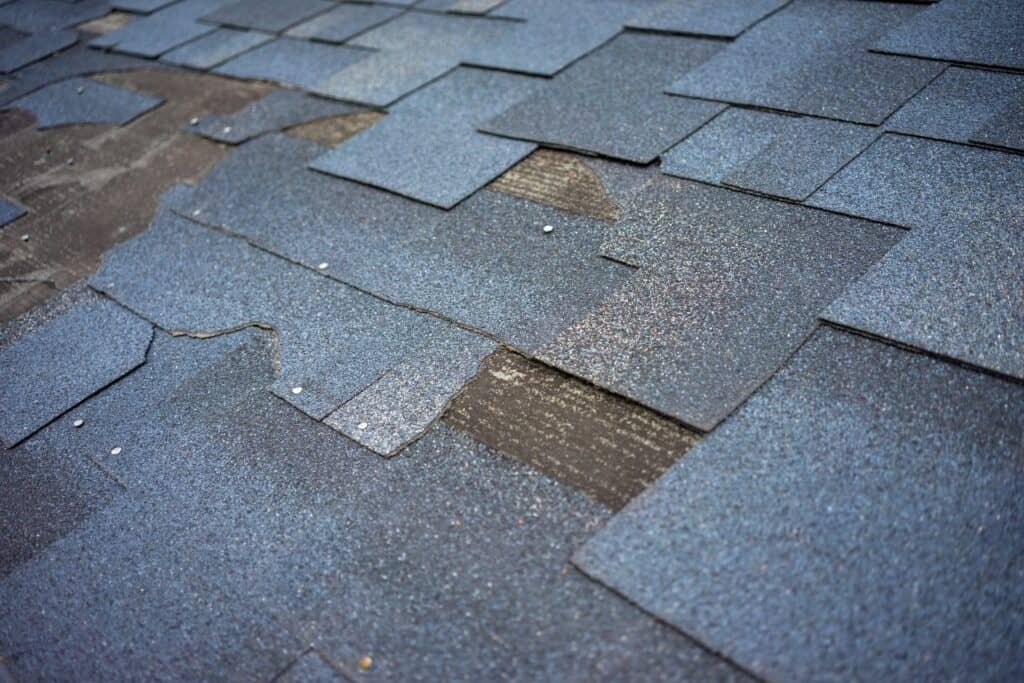
- Curling or buckling shingles. Shingles that curl at the edges or buckle in the middle have lost their ability to shed water and are near the end of their life.
- Cracked or broken shingles. Widespread cracking, often from age and heat, means the protective layer is failing across the roof.
- Bald spots and granule loss. Shingles that look bare have lost the granules that protect them from UV, and you will often find those granules piling up in your gutters.
- Missing shingles. A few can be replaced, but missing shingles in multiple areas point to a roof that is breaking down.
- Roof age. If your asphalt roof is past 20 years, it is on borrowed time even if it looks alright from the ground.
- Daylight or stains in the attic. Light coming through the roof boards or dark water stains mean moisture is getting in.
- Sagging roof deck. A dip or sag is a structural warning sign that needs prompt professional attention.
- Leaks or ceiling stains. Recurring leaks, especially in more than one spot, usually mean the roof system has failed.
- Damaged flashing. Cracked or rusted flashing around chimneys and valleys lets water in at the most vulnerable points.
- Higher energy bills. A failing or poorly ventilated roof can drive up cooling costs in the Texas summer.
Why These Signs Show Up Faster in Northeast Texas
Roofs here face hail, intense UV, and humidity that age them quickly. Hail can bruise shingles and strip granules even when there is no obvious hole, and months of summer heat dry out and crack asphalt. That is why a roof that might last 25 years in a mild climate can show the signs your roof needs to be replaced several years sooner here. After any major hailstorm, it is worth having the roof checked even if it looks fine from the driveway, because the damage that shortens a roof’s life is often invisible from the ground.
Replacement or Repair? How to Tell
Not every problem means a full replacement. Isolated damage on a relatively young roof, like a few missing shingles or one flashing leak, is usually a repair. Replacement makes more sense when the roof is near the end of its lifespan, the damage is widespread, or leaks keep showing up in different areas. When you are spending money repairing an old roof every year, that money is better put toward a replacement that solves the problem for decades. A professional inspection gives you an honest answer. Compare your options on our roof replacement page and our roof repair page.
What to Do If You Spot These Signs
If you notice one or more of the these warning signs, the smart first step is a professional inspection, not a panic purchase. A roofer will get on the roof, check the decking and ventilation, and tell you whether you are looking at a repair, a replacement, or possibly an insurance claim if storm damage is involved. Document anything you can see from the ground with photos, especially after a storm, and avoid climbing a damaged roof yourself.
Schedule a free, no-pressure inspection through our roof inspection page, and if storm damage is the cause, our insurance claims page explains the next steps. For a neutral overview of roof condition, the National Roofing Contractors Association is a helpful reference.
How Old Is Too Old?
Age is not a sign in itself, but it sets the odds on every other reason to replace your roof.
An asphalt roof in Northeast Texas typically gives fifteen to twenty-five years, depending on the product, the attic ventilation, and how many hail events have passed over it. Past about eighteen years, the decision to replace your roof usually comes down to timing rather than whether.
If you do not know the roof’s age, there are usually records. A permit history at the county, the prior owner’s paperwork, or a receipt in a drawer will place it. Failing that, the wear pattern itself tells an experienced eye roughly where the roof sits on its curve.
The useful reframing is this: a roof does not fail on a date. It becomes progressively more likely to fail, and planning to replace your roof before that happens costs less than reacting afterward.
What You Can See From the Ground
Before deciding to replace your roof, it is worth working out what you can establish yourself.
You do not need to climb anything. A pair of binoculars and ten minutes will tell you most of what matters.
- Look along each edge line. A ridge or eave that is no longer straight means shingles have lifted or the deck beneath has moved.
- Look for dark patches in the field, which usually indicate granule loss rather than shadow.
- Check the ridge cap for missing or cocked pieces.
- Look at the valleys, where water concentrates and wear shows first.
- Check the gutters for accumulated granules.
- Look at the flashing around chimneys and walls for anything lifted or rusted.
Any one of these on its own is a repair. Several of them together across different parts of the roof is the pattern that says it is time to replace your roof rather than patch it again.
What Only Shows From the Attic
The attic is the half of the inspection homeowners skip, and it carries most of the evidence for whether to replace your roof.
Take a flashlight up on a bright day and switch it off. Any daylight through the deck is a hole. Then look at the underside of the sheathing for dark staining around nails or along seams, which marks past leaks or condensation.
Press on anything discolored. Sound decking is firm and unyielding. Decking that gives under a hand has been wet long enough to lose strength, and it will not hold a nail. Widespread soft decking is the clearest structural argument to replace your roof there is.
Damp or compressed insulation tells the same story from underneath, and rusted nail tips indicate condensation, which points at ventilation as well as at the roof surface.
Signs That Look Alarming But Usually Are Not
Not everything that looks wrong means you need to replace your roof, and a few things get homeowners worried unnecessarily.
Dark streaking down a north-facing slope is almost always algae. It is cosmetic, it does not shorten the roof’s life meaningfully, and it can often be cleaned or left alone.
Moss and lichen are more of a concern because they hold moisture against the surface, but on a roof with years left they are a maintenance item rather than a replacement trigger.
A small number of missing shingles after a storm is a repair. So is a single leak at a pipe boot, which is one of the most common and most fixable faults on any roof. None of those, on their own, mean it is time to replace your roof.
What a Buyer’s Inspector Will Flag
If a sale is anywhere in your plans, it is worth knowing how a roof reads to someone else’s inspector.
They will note the estimated age, any visible granule loss, the condition of flashing and boots, whether there are multiple layers, and anything they can see in the attic. They will not usually assess remaining life precisely; they will flag concerns, and the buyer’s agent will turn those into a negotiating position.
A roof near the end of its life is one of the largest single items in a residential negotiation. Choosing to replace your roof before listing often returns more than it costs, and it certainly removes an argument. Doing it under contract, at speed, rarely goes as well.
Planning and Budgeting
Almost nobody budgets to replace your roof until it is urgent, which is what turns a planned expense into a stressful one.
- Start watching at fifteen years. An annual inspection from that point costs nothing and tells you where you stand.
- Get a written figure early, before you need it, so the number is not a surprise.
- Know your insurance position. Whether your policy pays replacement cost or actual cash value changes what a storm claim would leave you to fund.
- Ask about financing before you need it rather than during an emergency.
- Book in a quiet month if you can. After a regional hail event every roofer is committed.
Deciding to replace your roof on your own timetable is materially less expensive and calmer than doing it on the roof’s.
What Replacement Day Actually Involves
Knowing what happens when you replace your roof removes most of the apprehension, and it is a short list.
The old roof comes off to the deck, which is the only way to see what is underneath. Damaged sheathing is replaced. Underlayment, drip edge and ice-and-water membrane go down. Then starter course, field shingles, ridge caps and the flashing at every penetration. Ventilation is corrected at the same time, because the deck is open and it will never be easier.
A typical single-family roof is one to two days. The site is covered before work starts, and a magnet sweep for nails is part of the finish rather than an extra. If you plan to replace your roof this year, that is the shape of the day.
Choosing When, Not Just Whether
Once the signs agree that it is time to replace your roof, the remaining question is timing, and that has real consequences.
Shingles seal by warmth. A roof installed in mild weather bonds quickly and reaches its rated wind resistance within days. One installed during a cold snap may take weeks to seal, and until it does, that rating does not apply.
Demand matters too. After a hail event the whole region books out at once and materials tighten. A roof you knew was coming is far easier to schedule in a quiet month, which is another argument for deciding to replace your roof before circumstances decide for you.
Getting It Confirmed
Everything above is what a homeowner can reasonably assess before deciding to replace your roof. What it cannot settle is decking condition, remaining service life, or whether a repair would genuinely buy useful years.
Our roof inspections are free, include the attic, and come with photographs of what we found. If the roof has life left we will say so and tell you roughly how long. Repair and maintenance keep a sound roof going for years, and there is no reason to replace your roof before it needs it.
Where replacement is the right call, our roof replacement page sets out the process, and we provide a written written figure so you can see exactly what each part costs. If a storm was involved, insurance claims covers that side.
For independent reference, the National Roofing Contractors Association publishes homeowner material at nrca.net, and the Texas Department of Insurance covers coverage questions at tdi.texas.gov.
Two Layers, and Why It Changes the Answer
If a previous roof was laid over the original rather than torn off, that changes the decision to replace your roof before any other sign is considered.
You can often tell from the ground by looking at the roof edge, where two layers read as a thicker profile at the eave. A second layer traps heat between the courses, which ages the upper roof faster, and it means nobody has inspected the decking in however long the overlay has been up.
When the time comes to replace your roof on a two-layer house, both layers come off, so tear-off and disposal cost more. That is worth knowing at budgeting stage rather than on the day, and it is one of the main reasons we do not recommend overlays.
When One Slope Fails Before the Others
Roofs rarely wear evenly, and one plane is often visibly worse than the rest long before you need to replace your roof entirely.
The south and west faces take the most sun and usually age first. A slope shaded by a large tree may stay damp and grow moss while the rest of the roof is dry. A plane that caught the brunt of one storm can be damaged while its neighbors are untouched.
Where the difference is dramatic, replacing a single plane is sometimes a genuine option rather than a compromise, particularly where planes are separated by a ridge or a wall so the color difference does not show. Where the whole roof is simply aging at different rates, it is usually better to replace your roof in one go than to chase it slope by slope.
What It Costs to Wait Too Long
Deferring the decision to replace your roof is legitimate, and it is worth being clear about what that buys and costs.
Water does not stay where it enters. It tracks along rafters and spreads well beyond the original point, so each rain enlarges the affected area. Sheathing softens, insulation compresses and stops insulating, and eventually framing is involved. What would have been a straightforward job to replace your roof becomes carpentry first.
There is an insurance dimension as well. Policies cover sudden damage, not deterioration. Damage a carrier judges to have developed gradually because a known problem went unaddressed can be denied, and long-term staining in an attic makes that argument easy for them to make.
The honest summary is that waiting rarely saves money. It moves the expense and usually enlarges it.
Signs in the House Rather Than on the Roof
Some of the clearest indications that it is time to replace your roof show up indoors, where people notice them without connecting them to the roof at all.
- A stain on a ceiling that grows slowly, or reappears after rain.
- Paint or wallpaper lifting on an upstairs wall.
- A musty smell in a closet or upstairs room.
- Rising cooling bills with no other explanation, which can point at a hot attic.
- Daylight visible at the top of a wall or in a garage.
None of those prove the roof is finished. All of them are worth investigating, because by the time water is visible inside, it has usually been moving for a while.
Why Northeast Texas Homeowners Trust DJJ Roofing
DJJ Roofing has served Northeast Texas since 2015 as a family-owned company known for honest assessments, not scare tactics. If your roof only needs a repair, we will tell you. We are fully insured, a BBB Accredited Business, Google Guaranteed, and an Owens Corning Preferred Contractor, with a 4.9 star rating across 76 Google reviews. From our base at 124 Como St S in Sulphur Springs, we serve Hopkins County and the surrounding area. Call us at (903) 217-5431 for a free inspection.
How a Professional Roof Inspection Confirms It
From the ground you can only see so much, which is why a professional inspection is the step that turns a hunch into a decision. A roofer walks the roof and checks the shingles up close for bruising and granule loss, examines the flashing around chimneys and valleys, looks for soft or sagging decking, and inspects the attic for moisture, stains, and proper ventilation.
They also document everything with photos, which is exactly what you need if storm damage turns the situation into an insurance claim. A good contractor will give you a straight answer about whether a repair will get you a few more years or whether replacement is the smarter spend, and they will not pressure you into a roof you do not need.
What Happens If You Wait Too Long
Ignoring the signs of roof failure almost always costs more in the end. A roof that is past its life lets water reach the decking, the insulation, and eventually the ceilings and walls, turning a roofing project into a roofing-plus-drywall-plus-mold project. Water intrusion can also damage electrical and lead to rot in the structure. On top of the repair costs, an aging or leaking roof can hurt your insurance coverage and your home’s value. Replacing on your own schedule, before a failure, is far less expensive and less stressful than replacing in an emergency during storm season.
Frequently Asked Questions
What are the most common signs your roof needs to be replaced?
The most common signs are widespread curling, cracking, or missing shingles, granules collecting in the gutters, attic leaks or stains, a sagging deck, and a roof age past 20 years. Several of these together usually mean replacement rather than repair.
How do I know if it is a repair or a full replacement?
Isolated damage on a younger roof is usually a repair, while widespread wear, repeated leaks, or an aging roof point to replacement. A professional inspection gives you a clear, honest answer.
Can a roof look fine but still need replacing?
Yes. Hail damage and granule loss are often invisible from the ground, and interior leaks can start before the roof looks bad from the street. That is why inspections after storms matter.
How long does an asphalt roof last in Texas?
Most asphalt shingle roofs in Texas last 15 to 30 years depending on the grade, with heat and hail pushing them toward the lower end. Once you pass 20 years, watch closely for the warning signs.
Will insurance pay for a roof replacement?
If the damage came from a covered event like hail or wind, your Texas policy may cover replacement minus your deductible. A documented inspection report is what gets a claim approved.
Seeing the warning signs? Get a free, no-obligation roof inspection from DJJ Roofing before a small problem becomes a big one. Call (903) 217-5431 or contact us.