The short version
- Gutters protect the roof edge, the fascia and the foundation, in that order.
- A blocked gutter holds water against the drip edge, and that is where fascia and eave decking rot.
- Twice a year is the usual clearing rhythm in Northeast Texas, more if you have pines or oaks close by.
- Undersized downspouts fail more often than undersized gutters. Count the outlets, not just the run.
- Seamless gutters have joints only at corners and outlets instead of every ten feet.
- Discharge four to six feet from the foundation. In clay soil that is the least expensive protection there is.
Most homeowners think of gutters as a minor detail, but gutters and your roof work as a team, and neglected gutters are behind some of the most expensive roof and home damage we see in Northeast Texas. When gutters clog or fail, water backs up under the roof edge, overflows against the foundation, and rots fascia and decking. This guide explains how gutters protect your roof, what happens when they fail, and how simple maintenance prevents costly repairs.
How Gutters Protect Your Roof
Gutters exist to move water away from your home in a controlled path. They catch rain running off the roof and channel it through downspouts away from the foundation. When gutters and your roof are working together, water never lingers at the roof edge or pools around the house. That protects the fascia and soffit, the roof decking, the siding, and the foundation all at once. In a region with heavy spring downpours, that controlled drainage matters a great deal.
What Happens When Gutters Fail
Clogged or damaged gutters cause water to back up where it does not belong. That backed-up water can seep under the shingles at the eaves, rot the fascia board and roof decking, overflow and erode the soil around your foundation, and in winter contribute to ice and moisture problems. Over time, a neglected gutter turns into rotted wood, roof leaks, and even foundation issues, all of which cost far more to fix than keeping the gutters clean would have.
Gutter Maintenance That Prevents Damage
- Clean gutters at least twice a year, and more often if you have overhanging trees.
- Check downspouts to make sure water flows freely and drains away from the foundation.
- Look for sagging or pulling away from the fascia, which signals loose fasteners or water weight.
- Inspect after storms for dents, debris, and granules washed down from aging shingles.
- Consider gutter guards if trees constantly clog your gutters.
We offer professional gutter cleaning and seamless gutter services to keep this part of your roof system working.
Signs Your Gutters Are Hurting Your Roof
Watch for water stains on the fascia or siding, peeling paint near the roofline, gutters that overflow during rain, pooling water near the foundation, and granules collecting in the gutters. Any of these means water is not draining the way it should, and your roof and home are at risk. Catching it early is the difference between a cleaning and a repair.
Seamless Gutters vs. Sectional Gutters
Traditional sectional gutters have seams where pieces join, and those seams are the most common spots for leaks and clogs. Seamless gutters are formed in one continuous piece to fit your home, with far fewer joints, which means fewer leaks and less maintenance. For most Northeast Texas homes, seamless gutters are the more durable, lower-hassle choice and pair well with a new roof.
How Water Actually Moves Off a Roof
A roof sheds water by slope alone. Everything above the eave is simple: rain lands, runs down the shingle courses, and leaves at the bottom edge. The complicated part starts at that edge, and that is the relationship between gutters and your roof.
At the eave, water has to make a controlled turn. It runs off the last shingle course, past the drip edge, and into the trough. If any part of that handoff is off by an inch or two, water finds the fascia board instead of the gutter.
That is why gutter maintenance so often gets filed under roofing. The homeowner sees a stain on the soffit or paint peeling off the fascia and assumes the roof is leaking. Frequently the roof is fine and the water simply never made it into the trough.
Sizing: Five-Inch and Six-Inch Gutters
Most homes in Northeast Texas carry five-inch K-style gutters, and for a modest roof with a moderate pitch that is usually enough. The question is whether the roof feeding them is modest.
Two things drive the volume arriving at the eave: the area of roof draining to that run, and how steep it is. A steep roof delivers water faster than a shallow one because the water has less time to spread out. A long run with a single downspout concentrates everything at one end.
Six-inch gutters hold roughly forty percent more water than five-inch, and they pair with a larger downspout. On a large or steep roof that is not an upgrade so much as correct sizing. Overflow during heavy rain is often a capacity problem rather than a blockage.
- Large roof planes draining to one gutter run.
- Steep pitches that move water quickly to the edge.
- Valleys that dump into a gutter, concentrating two planes into one point.
- Long runs with only one downspout at the end.
Downspouts Are the Part That Gets Undersized
A gutter is a holding trough. The downspout is what actually removes the water, and it is the piece most often outnumbered by the roof above it.
The usual guidance is one downspout for every thirty to forty feet of gutter run, and more where a valley concentrates flow. Plenty of houses run sixty feet of gutter to a single outlet, which works in ordinary rain and overflows in the sort of storm this region gets several times a year.
Where the downspout discharges matters just as much. Water dumped at the base of the wall goes into the soil against the foundation. An extension or a buried line that carries it several feet away costs very little and solves a problem that is expensive later.
Drip Edge: The Piece Between Them
Drip edge is a strip of metal flashing installed along the eaves and rakes, under the shingles and over the fascia. It is the physical link between gutters and your roof, and it is the detail that decides where water goes at the handoff.
Without it, water running off the shingles can wick backward along the underside of the edge and onto the fascia and sheathing. That is the classic route to rotten fascia behind a gutter that looks perfectly healthy from the ground.
Drip edge is required by current code on new roofs and it is inexpensive. If a roof has been replaced in recent years it almost certainly has it. On older roofs it is frequently missing, and it is one of the first things worth checking when fascia keeps failing.
What Gutter Guards Do and Do Not Do
Guards reduce how often gutter maintenance is needed. They do not make a gutter maintenance-free, and no honest product claim says otherwise.
Mesh and micro-mesh screens keep leaves and larger debris out and work well under oak and pecan. What still gets through is the fine material: shingle granules, pine needles, blown dirt and pollen, which pack into a layer at the bottom of the trough over several seasons.
Reverse-curve designs shed leaves reliably but can struggle with the volume off a steep roof, where water overshoots the curve in heavy rain. That is worth knowing before buying rather than after the first big storm.
Guards are a reasonable purchase on a house surrounded by trees. They are a poor substitute for correct sizing, and they will not fix a gutter that overflows because the run is too long for its downspout.
Freeze Events and Standing Water
Northeast Texas does not have a real ice dam season the way northern states do, but the region gets hard freezes, and a gutter full of wet debris behaves differently from an empty one.
Water sitting in a blocked trough freezes and expands. That can pull a gutter away from the fascia at its hangers, open the seams on a sectional run, and put a surprising amount of weight on the board holding it up. A clear gutter drains before the temperature drops and largely avoids this.
The 2021 freeze made the point for a lot of homeowners. The damage that showed up afterward was often not the roof surface at all, but gutters that had been carrying debris and could not drain.
Gutters and Your Foundation
This is not strictly a roofing subject, but it is the most expensive consequence of ignoring gutters, so it belongs here.
The soils across much of this part of Texas are expansive clay. They swell when wet and shrink when dry, and they move a great deal between a rainy spring and a dry August. Foundations move with them.
A roof sheds thousands of gallons a year. Delivered evenly away from the house, that is unremarkable. Dumped in a few concentrated spots at the base of the wall, it keeps part of the soil saturated while the rest dries out, and differential movement is exactly what cracks slabs.
Gutters are inexpensive foundation insurance. That is worth saying plainly, because they are usually treated as a cosmetic trim item.
Gutter Maintenance, Repair, or Replacement
Not every gutter problem needs new gutters, and plenty are solved by gutter maintenance alone. Several of the common ones are genuinely repairs.
- Sagging sections are often loose or spaced-out hangers rather than a failed trough.
- Leaking corners and end caps on a sectional system can be resealed.
- Poor slope can sometimes be reset without replacing material.
- A single damaged length can be swapped on a sectional run.
- Missing downspouts are an addition, not a replacement.
Replacement makes more sense when the fascia behind the gutter has gone soft, when a sectional system is leaking at most of its seams, or when the system is simply too small for the roof. In that last case replacing like for like repeats the original problem.
If the roof is also near the end of its life, doing both together is usually the better sequence, because the eave detail and the seamless gutters can be set up as one system rather than fitted around each other.
A Gutter Maintenance Rhythm That Works Here
Twice a year of gutter maintenance suits this climate, with the timing driven by what is actually falling.
- Late fall, once the trees are bare, to clear leaves before winter rain.
- Late spring, after the oak and pecan drop and the storm season has passed, to clear catkins, seed and granules.
- After any severe storm, because a single event can fill a gutter with debris and shingle granules.
- Any time you see overflow during ordinary rain, which is the clearest signal there is.
Good gutter maintenance looks at the water, not only the debris. Run a hose into the far end of the run and watch whether it reaches the downspout, whether it pools anywhere, and whether anything drips at the seams or behind the trough.
What We Look At During an Inspection
A roof inspection here includes the eave rather than stopping at the shingles, because the two are one system. Gutters and your roof fail together far more often than either fails alone.
We look at whether drip edge is present, whether the gutter sits at the right height relative to the shingle overhang, whether the slope actually carries water to the outlets, and what condition the fascia and soffit are in behind the trough. Downspout count and discharge point get noted as well.
Most of what turns up is small. A rehung section, a resealed corner, an added downspout. It only becomes expensive when it has been quietly wetting fascia and sheathing for a few years, which is the case worth catching. Our roof inspections are free, and a gutter maintenance check is part of them rather than an extra.
Further Reading
For homeowners who want to read beyond a contractor’s summary, the National Roofing Contractors Association publishes technical guidance on roof edge detailing and drainage at nrca.net. The Texas Department of Insurance also maintains plain-language material on storm preparation and property damage at tdi.texas.gov, which is worth a look before a storm season rather than after one.
If something in this piece matches what your house is doing, get in touch and we will take a look at the roof and the gutter line together. If it turns out to be a roof repair rather than a drainage problem, we will tell you that instead.
Why Gutter Maintenance Gets Skipped
Gutters are the least interesting part of a house. They are not a room, they do not show, and nothing obvious happens the week they are neglected. Gutter maintenance therefore loses every scheduling argument it has with a more visible project.
The trouble is that the damage accumulates quietly and then presents all at once, usually as soft fascia, a stained soffit, or water in a place that suggests the roof is leaking. By that point the repair is carpentry rather than cleaning.
Roughly speaking, an afternoon of gutter maintenance twice a year prevents a category of repair that runs into four figures. That ratio is the entire argument, and it is why we raise gutter maintenance during roof inspections even when nobody asked.
What Gutter Maintenance Actually Involves
There is less to it than people expect, and the order matters more than the tools.
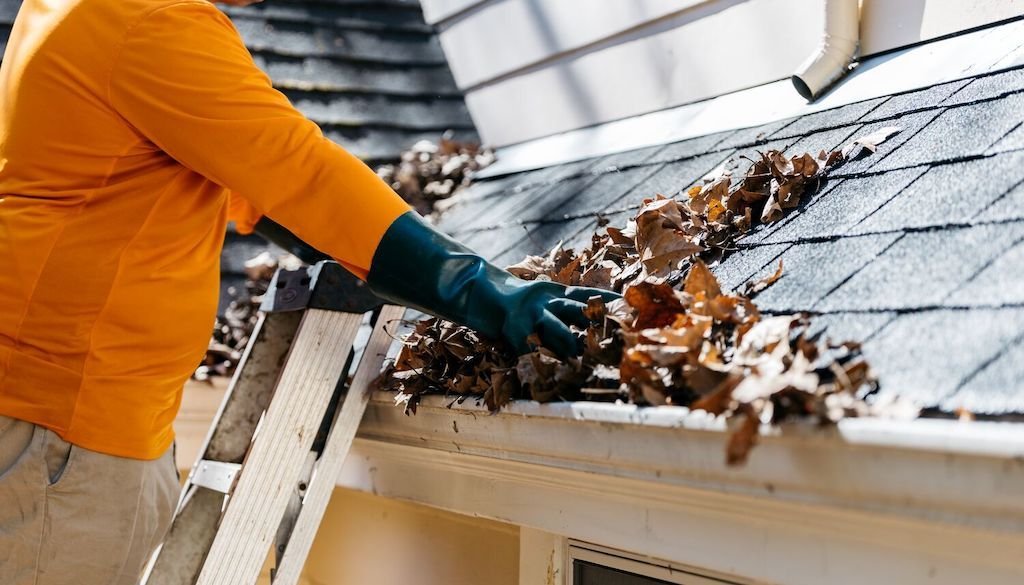
- Clear the trough by hand from the far end toward the outlet, so debris is not pushed into the downspout.
- Flush the downspout separately, from the top, and confirm water leaves at the bottom.
- Check the hangers. Any that have pulled loose will let the run sag and hold water.
- Look behind the trough at the fascia board, which is where the expensive damage starts.
- Run water the full length and watch where it pools, drips, or overshoots.
- Note the discharge point and whether it carries water clear of the foundation.
Most of that is observation rather than labor. The value in gutter maintenance is less in the cleaning and more in noticing the loose hanger or the damp fascia while both are still trivial.
Gutter Maintenance After a Storm
A severe storm changes the job. Ordinary seasonal gutter maintenance deals with leaves; storm cleanup deals with shingle granules, and those behave differently.
Granules are heavy, they settle into a dense layer, and they pack rather than float. A trough that drained perfectly in October can hold standing water after one hailstorm has scoured the roof above it. Finding a thick bed of granules is also a signal about the roof surface itself, not just the gutter.
That is the part worth acting on. If post-storm gutter maintenance turns up a lot of granule loss, the roof deserves a proper look at the same time. Our storm damage assessments cover both, because the gutter is often where the first evidence lands.
Doing It Yourself, or Not
Plenty of homeowners handle their own gutter maintenance, and on a single-story house with a moderate roof that is entirely reasonable. The honest considerations are height and footing rather than skill.
Most gutter injuries involve a ladder on soft or uneven ground, or somebody reaching sideways instead of moving the ladder. A two-story eave, a steep slope beneath the ladder feet, or a wet morning are all good reasons to leave it.
The other case for having it done is simply that someone on a ladder every six months notices things. Gutter maintenance performed by somebody who also looks at the roof edge, the drip edge, and the fascia is worth more than the cleaning alone. That is how a rotten board gets caught at the board stage.
What Gutter Maintenance Costs Against What It Prevents
The arithmetic is worth laying out, because gutter maintenance is one of the few house jobs where the numbers are not close.
Clearing a typical single-story run is an afternoon of your own time, or a modest service call twice a year. Against that sit the repairs it prevents. Replacing a run of rotten fascia means carpentry, priming and paint. Replacing damp roof sheathing at the eave means opening the roof edge. Foundation work from years of concentrated discharge is in another bracket entirely.
None of those arrive suddenly. They are the slow result of water going somewhere it was not meant to, for several seasons, while everything looked normal from the street.
The least expensive outcome is always the one where gutter maintenance happens on a schedule and nothing ever becomes a project. That is an unsatisfying argument, because the reward is an absence of events, but it is the honest one.
Gutter Maintenance and a New Roof
If a roof replacement is coming, the eave is the moment to get this right rather than to tidy up afterward.
During a replacement the drip edge is set, the shingle overhang is established, and the gutter position relative to both is decided. Getting that geometry correct means ordinary gutter maintenance is all the system ever needs. Getting it wrong means a run that overshoots in heavy rain no matter how clean it is.
It is also the only convenient time to see the fascia. Once the old roof edge is off, soft boards are obvious and inexpensive to swap. Discovering the same rot later means taking the gutter down to reach it.
So if a roof replacement is on the horizon, raise gutter maintenance in the same conversation. It is a small part of that job and an awkward one on its own.
Why Homeowners Choose DJJ Roofing
DJJ Roofing treats gutters as part of the complete roof system, not an afterthought. We clean, repair, and install seamless gutters that protect your roof and foundation. Serving Northeast Texas since 2015, we are fully insured, a BBB Accredited Business, Google Guaranteed, and an Owens Corning Preferred Contractor, with a 4.9 star rating across 76 Google reviews. Call (903) 217-5431 or schedule a roof inspection.
Frequently Asked Questions
How do gutters protect my roof?
Gutters channel rain off the roof and away from the foundation in a controlled path, protecting the fascia, decking, siding, and foundation from water damage.
How often should I clean my gutters?
At least twice a year, and more often if trees overhang your roof. Cleaning after major storms is also smart.
What happens if I never clean my gutters?
Water backs up under the shingles, rots the fascia and decking, overflows against the foundation, and can cause roof leaks and structural damage that cost far more than cleaning.
Are seamless gutters better?
Yes, generally. Seamless gutters have far fewer joints than sectional gutters, so they leak and clog less and need less maintenance.
Can clogged gutters cause a roof leak?
Yes. Backed-up water can seep under the shingles at the eaves and into the decking, leading to leaks and rot.
Protect your roof from the ground up. Ask DJJ Roofing about gutter cleaning and seamless gutters. Call (903) 217-5431 or contact us.