Commercial Roofing in Greenville, TX
We handle commercial roofing in Greenville and across Hunt County from a single yard on Como Street South. Greenville sits straight down I-30 from us, so getting a crew and a load of material there is a short run. Every job starts with somebody on the roof taking pictures, and every price is written down before a shingle moves.
- TPO, modified bitumen and low-slope systems
- Scheduled around your trading hours
- Free assessment and written scope
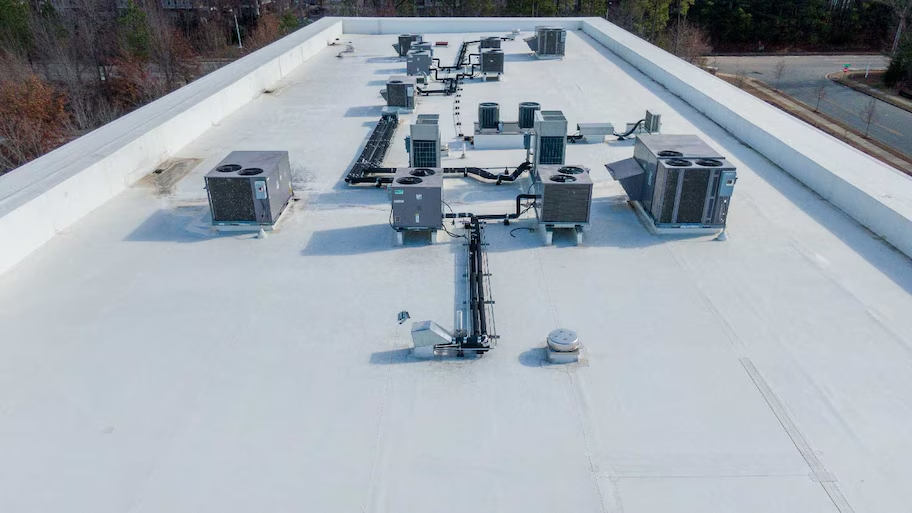
Commercial roofing for Greenville businesses
Low-slope roofs fail differently from houses. Water does not run off, it sits, and that changes what matters: seams, terminations, drainage and detail work around everything that comes through the deck.
All of it is covered by the written estimate for commercial roofing in Greenville before any work starts. If something turns up once we are on the roof, you see a photograph of it and decide what to do, rather than finding it as a line on an invoice afterwards.
That is the scope every quote for commercial roofing in Greenville is written against.
TPO and single-ply
Heat-welded seams, mechanically attached or fully adhered. The reflective surface keeps a Greenville building cooler through a Texas summer, which shows up on cooling costs. We do this on every Greenville job whether or not anybody thinks to ask for it.
Roof-mounted equipment
Curbs, sleepers and walkway pads around units that get serviced. Foot traffic on a low-slope roof does real damage when there is nothing protecting the membrane. We do this on every Greenville job whether or not anybody thinks to ask for it.
Documentation a manager can use
Before and after photographs of every penetration and termination, plus a written scope. It is what a manager needs to take to an owner, and it supports a claim later. On a Greenville roof that is part of the same visit rather than a separate call-out.

Why Greenville gets its own page
Greenville is the biggest town in Hunt County and it shows in the roof stock. There is a large stock of mid-century homes near the older streets, a lot of 1990s and 2000s shingle in the subdivisions off the loop, and commercial and light industrial buildings along the I-30 corridor running low-slope membrane.
Greenville sits straight down I-30 from us, so getting a crew and a load of material there is a short run. That matters more than it sounds. A crew that works the same counties every week already knows which subdivisions went up with builder-grade shingle and which older streets have the cut-up rooflines where flashing does the real work.
It also means the office that writes your estimate is the office that answers the phone in year three. You can read more about the town itself on our Greenville page, or about the service generally on our Commercial Roofing page.
The short version is that we are close enough to Greenville to be useful and small enough to care whether the job was right. Both of those matter more in year three than they do on the day.
The three things Greenville roofs take
Hunt County is squarely in the spring hail corridor, and the flat farmland west of Greenville gives straight-line wind a long clean run at a roof. That combination is why we photograph every slope rather than the one you asked about. Damage around Greenville is very often on a single elevation.
That is what the free inspection is for. Before we quote commercial roofing in Greenville we photograph every slope, so you can see which of these has actually happened to your roof rather than guessing at it from the ground.
All of it feeds into what commercial roofing in Greenville actually has to address.
Spring hail
March through June is when Hunt County takes most of its hail. The damage that matters is bruising and granule loss, neither of which leaks on the day and both of which shorten the roof.
Straight-line wind
Wind does not need to remove a shingle to do harm. Lifting a tab far enough to break the self-seal strip is enough, and the shingle lies back down looking untouched.
Summer heat
Texas summers cook a roof from both sides. Where attic ventilation is not balanced, the heat builds underneath and takes years off the shingle above it.
What we see on Greenville roofs
Storm work and replacements more than anything else. The farmland west of town gives wind a clean run, and Hunt County sits squarely in the spring hail corridor, so a large share of what we document in Greenville is impact bruising and broken seals rather than wear. On the commercial side it is nearly always the details: terminations, curbs and drains, not the field of the membrane.
The calendar here is set by the spring storm season more than anywhere else we cover. A single significant hail event fills the following six weeks with inspections and claim documentation. Outside that window it is planned replacements and commercial maintenance, and the commercial work is genuinely year-round because low-slope problems do not wait for a season.
What we work on here
Greenville is the largest town in Hunt County and the roof stock reflects that. There is a substantial body of mid-century housing on the older streets, a lot of 1990s and 2000s shingle in the subdivisions out toward the loop, and genuine commercial and light industrial stock along the I-30 corridor running low-slope membrane rather than shingle. Very little of it is new construction.
How long we have been here
Greenville has been part of our regular run since the early years, largely because the I-30 corridor makes it straightforward to reach and because Hunt County generates steady storm work every spring.
About the area
The older residential streets carry a lot of mid-century housing with original roof geometry, which means cut-up rooflines and more flashing per square foot than newer construction anywhere else in the county.
Almost never in the middle of the field
On a commercial building in Hunt County the membrane itself is rarely the problem. Failures gather at the edges and around anything that penetrates the deck.
This is why our inspection covers the whole roof rather than the one slope you asked about. Around Greenville it is common for the problem you noticed and the problem that matters to be on different elevations.
Penetrations and curbs
Every unit, vent and conduit through the deck is a place the membrane has been cut and sealed back. Those seals age faster than the field. This turns up across Hunt County on roofs of every age.
Wet insulation
Once water is in the insulation it spreads well beyond the entry point, and the roof is heavier and less efficient everywhere it has traveled. A frequent finding on the properties we inspect around Greenville.
Pitch pockets
Sealed around conduit and supports, and the detail with the shortest life on the whole roof. They want checking every year. We find this often on Greenville roofs.
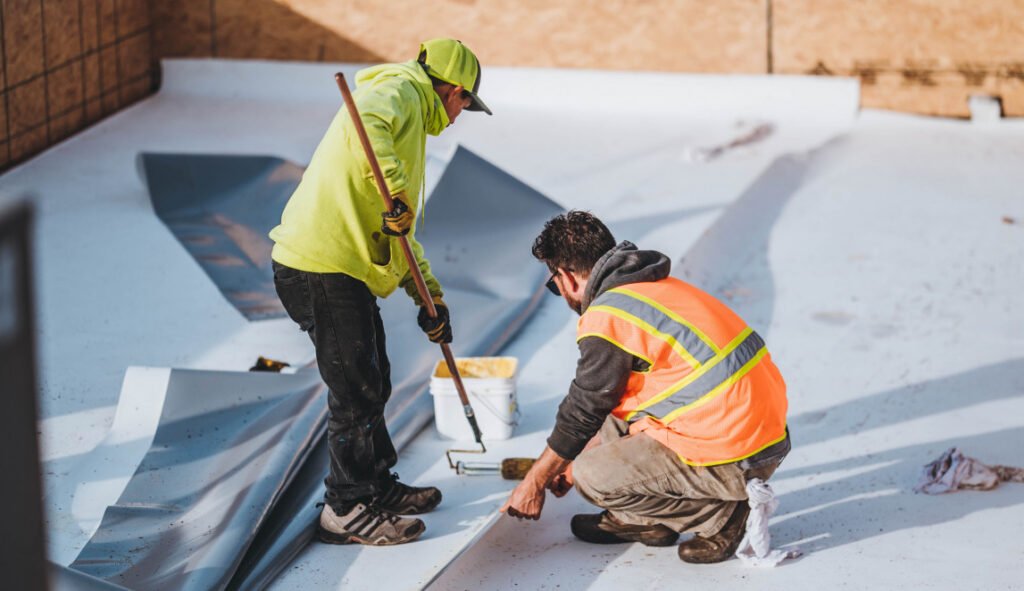
How a commercial job runs in Greenville
Commercial work is scheduled around a business rather than the other way round. The sequence does not change; the timing is yours.
Nothing in that sequence costs you anything until you agree to the written estimate. The inspection, the photographs and the quote for a Greenville property are free either way.
Assessment
We walk the roof, photograph every penetration and termination, and check the drainage pattern after rain where we can. The same sequence runs at every Greenville address.
Written scope
What has failed, what we propose and what it costs, set out so an owner or a board can read it without translation. The same sequence runs at every Greenville address.
Scheduling
Around your trading hours where the work allows it. Most Greenville businesses do not need to close for roofing work. No Greenville job skips this stage.
Installation
Staged so the building is watertight at the end of every day, whatever the forecast decides to do overnight. This does not change from one Hunt County job to the next.
Handover
Photographs of the finished detail work, and a walk of the roof with whoever maintains the building. Standard on all our Hunt County work.
Six signs a Greenville commercial roof needs attention
Low-slope roofs do give warning, and the warning usually appears inside the building before it appears on top of it. These are the ones worth acting on.
You do not need all six to justify a call. Any one of them means something has changed on the roof, and the free inspection will tell you how much it matters and whether it can safely wait until next year.
Ceiling tiles staining
The classic first sign in a commercial building. By the time a tile stains, water has been tracking along the deck for a while. A regular finding across Hunt County, and rarely urgent on the day.
Seams lifting or open
On single-ply, the seam is the weak point by design. A seam you can get a finger under is an active problem. It shows up on Greenville roofs of every age, not only the old ones.
Cracked or open pitch pockets
Every conduit and support through the deck is sealed with a detail that ages faster than the field of the roof. A regular finding across Hunt County, and rarely urgent on the day.
Loose edge or parapet metal
Wind gets under a loose termination and peels inward. This is the failure mode that turns a repair into a replacement. It shows up on Greenville roofs of every age, not only the old ones.
Debris collecting in one corner
Where debris gathers, water sits, and where water sits the seams work harder than they were designed to. Worth a look from the ground at any Greenville address after a storm.
Patches from previous repairs
How many, and how well done, says more about a commercial roof than its age does. We photograph it on every Greenville inspection where it is present.
Which low-slope system suits the building
There is no single best commercial roof. There is one that suits the deck, the traffic and the budget of a particular Greenville building.
Any of these can be the right answer in Hunt County. The wrong answer is the one chosen without anybody looking at the roof first, which is why the inspection comes before the recommendation rather than after it.
Worth reading elsewhere: the National Roofing Contractors Association publishes the low-slope standards this work is built to, and Owens Corning documents the commercial systems we install.
TPO
Reflective single-ply with heat-welded seams. The usual choice for a Greenville building that wants lower cooling load and a long, clean service life. It works well on a large share of the roofs we see around Greenville.
Modified bitumen
Multi-ply asphalt system, very tough underfoot. Suits roofs that see regular foot traffic for equipment servicing. We install this regularly on Greenville properties.
Coatings and restoration
On a sound but aging membrane, a coating system can add years for a fraction of a replacement. It is not right for every Greenville roof and we will say when it is not. We install this regularly on Greenville properties.
Restoration coatings
A coating renews the surface of a membrane that is still sound underneath. Real years for a fraction of replacement, and the wrong answer over wet insulation. This comes up often on Greenville jobs and we will quote it on request.
What commercial roofing costs in Greenville
Commercial pricing follows square footage, system and access rather than a simple per-home figure. These are the variables that actually move it.
The range is wide because Greenville properties are. The only honest way to narrow it for commercial roofing in Greenville is to get on the roof and measure it, which costs nothing and carries no obligation whatsoever.
Area and deck type
Square footage first, then what the membrane is going over. A metal deck, a concrete deck and an existing membrane are three different jobs. This is established during the free inspection at your Greenville address.
Detail count
Two buildings of the same size can differ enormously in price if one has forty penetrations and the other has four. We measure rather than estimate it, on every Hunt County job.
Insulation and current code
Where a full replacement triggers current insulation requirements that is a genuine cost, and we flag it at the assessment rather than after the tear-off. It is assessed the same way on every Greenville job we quote.
A repair is often the right commercial answer
Where the membrane field is sound and the failures are at the details, repairing those details costs a fraction of replacement and buys real years. We will tell you which of those a Greenville roof is. See TPO roofing for more on the system we install most.
“Excellent service! We were pleased with the work that was completed. Reliable and affordable. Highly recommend!”
 Verified on Facebook
Why Greenville property owners call us
Four things worth checking about whoever ends up on your Greenville roof. We hold all four and we are happy to evidence every one of them before you agree to anything.
Every one of those is verifiable before you commit to anything. Ask us for the certificate of insurance, read the reviews at the source rather than the ones we chose to reprint, and keep the written estimate somewhere safe once you have it.
One shop, five counties
We work out of a single yard on Como Street South in Sulphur Springs and we have since 2015. Greenville sits straight down I-30 from us, so getting a crew and a load of material there is a short run. The office that quotes a Greenville job is the office that answers when you call about it later. It applies to every property we touch in Hunt County.
Photographs, not opinions
Every finding on a Greenville roof is photographed and the pictures are yours to keep whether or not you use us. You are deciding about something you can see. The same on a Greenville repair as on a full replacement.
In writing
What the work covers, with decking priced per sheet, and nothing added later that was not on the estimate you agreed to. It applies to every property we touch in Hunt County.
Insured and accredited
Fully insured, BBB Accredited, Google Guaranteed and an Owens Corning Preferred Contractor, with a 10-year workmanship warranty in writing. No exceptions, on any Greenville address.
Towns near Greenville
Scheduling around Greenville normally takes in the towns below as well, which is why a nearby job seldom means a longer wait. Every one of them has a page of its own with the local detail.
Other roofing work in Greenville
If you need something other than commercial roofing at a Greenville property, it is probably below. These are the eight jobs that make up nearly all of our work in Hunt County.
We keep a page per job per town rather than one page for everything because the honest answers differ. Roof age, pitch, material and exposure all change what the right work is at a Greenville address, and a page written for the whole region cannot say anything useful about any of them.
Questions we get about commercial roofing in Greenville
A properly installed and maintained TPO or modified bitumen roof commonly gives twenty years or more. What shortens it is almost always neglected detail work rather than the membrane wearing out in the field.
Twice-yearly inspections are what make the difference. Catching a lifting seam or a failed pitch pocket in year eight keeps a roof on course for twenty; finding it in year fourteen usually does not. For a Greenville address we would rather look at the roof than answer it in general terms, and looking costs nothing.
Yes. Barns, shops, shells and light industrial buildings around Hunt County are a regular part of the work, most of it metal panel or low-slope membrane.
Agricultural buildings in particular tend to be exposed-fastener metal over purlins, where the fasteners rather than the panels are the maintenance item. That is a quick inspection and an expensive thing to ignore. The honest answer for any particular Greenville property depends on what is actually up there, which is what the free inspection establishes.
Often, yes. Where a roof has several distinct sections, doing the worst first and the rest later is a legitimate plan rather than a compromise, as long as the joins are detailed properly. We will set out which sections are urgent and which can genuinely wait. That is the general picture. What it means for your Greenville roof is a question the photographs answer better than we can here.
A coating renews the surface of a membrane that is still structurally sound; a replacement removes it. Coatings buy real years for a fraction of the cost when the field is healthy and only the surface has aged. They are the wrong answer if there is wet insulation underneath. The honest answer for any particular Greenville property depends on what is actually up there, which is what the free inspection establishes.
It shows up as soft or spongy areas underfoot and as staining that spreads well beyond any obvious entry point. Wet insulation makes a roof heavier and much less efficient, and it does not dry out on its own. Finding it changes the recommendation from repair to replacement. For a Greenville address we would rather look at the roof than answer it in general terms, and looking costs nothing.
Get your free Commercial Roofing quote in Greenville
Fill this in and we will call you back to arrange a time that suits you. The inspection and the written estimate are both free, and if the roof turns out to be fine that is what the report will say.
Get Your Free Quote
Enter your details below and we will get back to you with a real number.
Start with a look at the roof.
We will walk the roof, photograph what we find and put a price in writing. What you do with it afterwards is entirely up to you, and the inspection costs nothing either way. If the roof turns out to have years left in it, that is what the report will say and there will be no invoice attached.
Ask us about commercial roofing in Greenville and we will tell you plainly what the roof needs.