The short version
- Ventilation is what stops a Texas roof aging from underneath.
- Trapped heat cooks the shingle from the back, and the granule loss shows up years early.
- Intake and exhaust have to balance. Adding exhaust without intake can make airflow worse.
- Signs of a problem: a hot upstairs, ice-free frost patterns in winter, and shingles curling with no storm to blame.
- Ridge and soffit venting is the usual pairing on a pitched roof out here.
- A manufacturer warranty can be voided by poor ventilation, so it is worth checking at replacement.
Attic ventilation is one of the most overlooked parts of a healthy roof, yet it has a huge effect on how long your roof lasts, how comfortable your home feels, and how high your energy bills run. In the Northeast Texas heat, poor ventilation quietly cooks your shingles from below and traps moisture that leads to mold and rot. This guide explains why attic airflow matters so much, the warning signs of a poorly ventilated attic, and how to get it right.
Why Attic Ventilation Matters for Your Roof
Your roof is a system, and airflow is a core part of it. Proper ventilation lets hot, humid air escape near the ridge while cooler air enters near the eaves, creating constant airflow through the attic. Without it, heat builds up under the roof deck and bakes the shingles from the underside, shortening their life, while trapped moisture condenses on the wood and insulation. Good ventilation protects the shingles, the decking, and the insulation all at once, which is why manufacturers often require it to keep a warranty valid.
What Happens Without Proper Ventilation
A poorly ventilated attic causes a chain of problems. In summer, trapped heat drives up cooling costs and ages shingles prematurely. In cooler, damp months, trapped moisture condenses and leads to mildew, mold, wood rot, and ruined insulation. Over time this can void shingle warranties and force an early roof replacement. Many homeowners blame their roof or their air conditioner for problems that actually trace back to inadequate attic airflow.
Signs of Poor Attic Ventilation
- Upstairs rooms that are much hotter than the rest of the house
- Unusually high summer cooling bills
- A hot, stuffy attic even in the evening
- Moisture, frost, or mildew smell in the attic
- Rusted nails or damp insulation
- Shingles that wear out faster than expected
If you notice several of these, your airflow is worth having checked during a roof inspection.
Types of Roof and Attic Ventilation
Good ventilation balances intake and exhaust. Intake usually comes from soffit vents at the eaves, while exhaust comes from ridge vents along the peak, or from box vents, gable vents, or powered fans. Ridge-and-soffit systems are the most common and effective for Northeast Texas homes because they create steady, balanced airflow. The right setup depends on your roof design, which is something a roofer evaluates during an inspection.
Ventilation and Your Roof Replacement
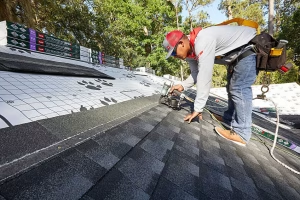
The best time to fix ventilation is during a roof replacement, when the roof is open and vents can be added or upgraded efficiently. A quality replacement always includes proper ventilation as part of the system, not an afterthought. If your old roof had ventilation problems, replacing it is the chance to solve them for good and protect your new investment. Learn more on our roof replacement page and our roof inspection page.
How Attic Ventilation Actually Works
Attic ventilation is not one vent or one fan. It is a loop. Cool air enters low, usually through the soffits under the eaves. Warm air leaves high, through a ridge vent or box vents near the peak. Heat rises on its own, so once both halves are open, the attic breathes without any moving parts.
That loop only works if both ends are clear. Exhaust with no intake pulls air from the easiest opening it can find, which is often the house itself. Intake with no exhaust has nowhere to send the heat. Either way the attic stops moving air, and the roof above it pays for it.
The rule of thumb roofers use is balance: roughly half the vent area at the intake and half at the exhaust. A roof can carry an impressive ridge vent and still run hot because the soffits behind it were packed shut with insulation years ago.
How Much Attic Ventilation Does a Texas Home Need?
Building codes describe ventilation in terms of net free area, which is the actual open space in a vent after the mesh and louvers are subtracted. A vent that measures a square foot might only deliver half that in real airflow, and the manufacturer publishes the number.
The common standard is one square foot of net free area for every 150 square feet of attic floor. If the attic has a sealed vapor barrier and the vent area is split evenly between intake and exhaust, that can relax to one in 300. On a 2,000 square foot attic that is somewhere between seven and thirteen square feet of opening.
Those figures are a floor, not a target. In Northeast Texas, where attic temperatures climb through the summer and humidity stays high, aiming at the more generous end of the range is usually the better call.
- Measure the attic floor, not the roof. A steep roof has more surface than the space underneath it.
- Use net free area from the product sheet rather than the size of the hole in the deck.
- Split it evenly. Intake and exhaust should be close to equal.
- Count what is already there. Gable vents, turbines and existing box vents all contribute.
Intake Is the Half Most Homes Get Wrong
When attic ventilation underperforms, the exhaust is rarely the problem. Ridge vents are visible, so they get installed and inspected. The intake sits out of sight under the eaves, and that is where it quietly fails.
The most common cause is insulation. Somebody adds a foot of blown insulation across the attic floor, it drifts out to the edges, and it buries the soffit openings. The insulation is doing its job. It is simply doing it on top of the air path.
Baffles fix this. A baffle is a rigid channel stapled between the rafters at the eave that holds a gap open above the insulation, so air can still pass from the soffit into the attic. They cost very little and they are far easier to install during a roof replacement than afterward.
Paint is the other culprit. Vented soffit panels that have been sprayed over several times lose a surprising amount of their open area to dried paint in the perforations.
Why Mixing Exhaust Types Causes Problems
Two different exhaust systems on the same attic can work against each other. A ridge vent and a powered fan are the usual pairing. The fan moves far more air than the ridge vent was designed around, so instead of drawing from the soffits it draws down through the ridge vent, which is the nearest large opening.
The result is a short circuit. Air cycles in and out of the top of the roof while the far corners of the attic never move at all. Adding more exhaust in that situation can make attic ventilation worse rather than better.
Gable vents paired with a ridge vent can do the same thing on a smaller scale. It is not always a problem, but it is worth looking at rather than assuming that more openings must mean more airflow.
What Attic Ventilation Does in a Texas Summer
An unventilated attic in July can run 40 degrees hotter than the air outside. That heat has two places to go: down through the ceiling into the rooms below, and up into the underside of the roof deck.
The first one shows up on the power bill and in the air conditioner running longer than it should. The second one is the expensive version. Shingles are designed to shed heat from above, not to be cooked from underneath, and sustained heat on the back of the deck ages the asphalt faster than sunlight alone.
Good attic ventilation does not make the attic cool. Nothing does in a Texas August. It keeps the attic closer to the outside air instead of tens of degrees above it, and that difference is what the roof actually feels.
What Attic Ventilation Does in Winter
The summer case is easy to picture. The winter one matters just as much and gets far less attention.
Every household puts moisture into the air, from cooking, showers, laundry and simply breathing. That moisture drifts upward. When it reaches a cold roof deck it condenses, and the underside of the plywood gets wet. Do that for enough winters and the decking softens, the nails rust, and mold takes hold in the insulation.
Moving air carries that moisture out before it can settle. This is why attic ventilation is not a seasonal system that only earns its keep in summer. A roof that was replaced because the decking had gone soft was often ventilated poorly for years before anyone noticed.
Attic Ventilation and Your Shingle Warranty
Most shingle manufacturers require adequate attic ventilation as a condition of their material warranty. Owens Corning, which we install as a Preferred Contractor, publishes ventilation requirements alongside its shingle specifications.
The reason is straightforward. A shingle cooked from below fails earlier than the same shingle on a ventilated roof, and the manufacturer does not want to underwrite an installation problem. If a claim is ever filed, ventilation is one of the first things assessed.
That is worth knowing before a roof goes on rather than after. Correcting intake during a roof replacement is a small part of the job. Going back into a finished attic to add baffles is a separate visit.
How to Check Your Own Attic Ventilation
You can learn a lot without a ladder or any tools. Most of it is noticing things you already walk past.
- Look up at the eaves from the ground. Are the soffit panels perforated or solid? Solid soffits mean no intake at all.
- Look at the ridge line. A ridge vent reads as a low raised cap running along the peak.
- Open the attic hatch on a hot afternoon. If the air that comes down is startling, the attic is holding heat.
- Take a flashlight to the eaves inside the attic. If you see daylight at the edges, the intake is open. If you see insulation packed to the roof deck, it is not.
- Check the decking for dark staining around nails or along seams, which points to past condensation.
- Listen for a powered fan. If one runs, note whether there is a ridge vent as well.
None of that is a substitute for someone measuring it, but it tells you whether attic ventilation is worth raising at your next inspection.
What an Inspection Looks At
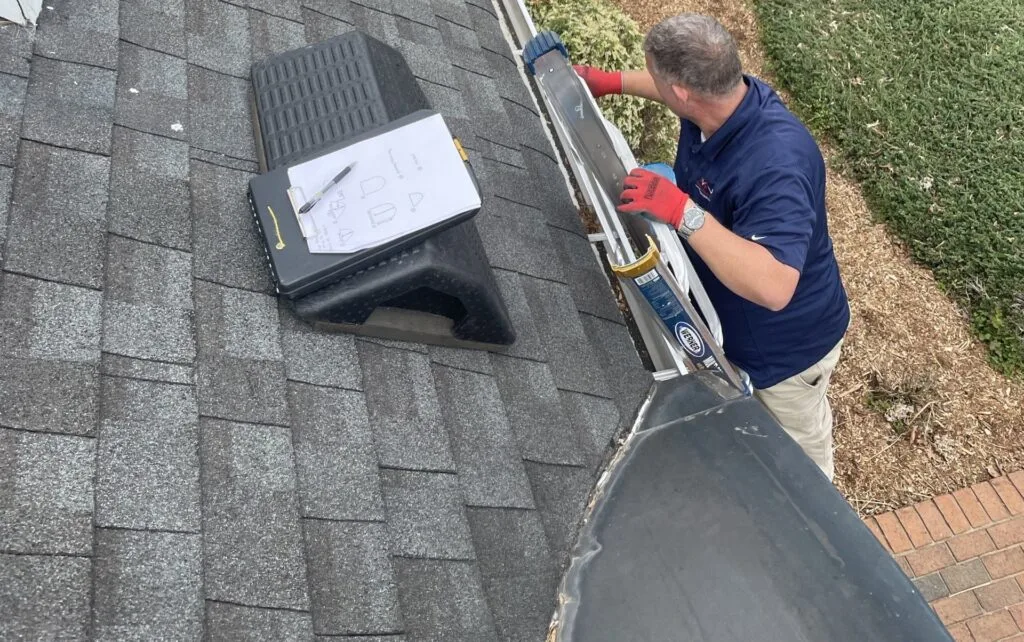
A roof inspection that includes ventilation covers both halves of the loop and the evidence in between. The exhaust gets measured for type and net free area, and the intake gets verified from inside the attic rather than assumed from the soffit panels outside.
From there it is a question of what the attic shows. Rusted nail tips, staining on the underside of the deck, compressed or damp insulation and a strong temperature difference between the attic and outside all point the same direction.
Our roof inspections are free, and the ventilation assessment is part of them rather than an add-on. If the intake is blocked, that is often a less expensive fix than homeowners expect and it is worth knowing about before it turns into decking work.
Common Attic Ventilation Mistakes
A few patterns come up again and again on Northeast Texas homes, and none of them are unusual or careless. They are simply the kind of thing that happens when a house is improved one project at a time.
- Insulation added without baffles. The single most common cause of blocked intake.
- Exhaust added without matching intake. More vents at the top do not help if the bottom is sealed.
- Bathroom fans venting into the attic rather than through the roof, which puts moisture exactly where it does the most harm.
- Soffit perforations painted over across several repaints.
- Mixing a powered fan with a ridge vent so the two compete.
- Storage blocking the eaves, which does the same thing insulation does.
The National Roofing Contractors Association publishes guidance on ventilation design for anyone who wants to read further, and the NRCA is a reasonable starting point. Owens Corning also documents its ventilation requirements for its shingle systems.
Is It Worth Fixing on an Older Roof?
If the roof has years left, yes. Correcting attic ventilation on a sound roof protects what is already there and slows the aging that would otherwise shorten it.
If the roof is near the end of its life, the better plan is usually to fold the ventilation work into the replacement. The deck is open, the eaves are accessible, and baffles and a ridge vent go in as part of the installation rather than as separate work.
Either way the decision benefits from someone actually looking. If you are weighing roof repairs against a replacement, attic ventilation is one of the factors that tips the math, because a poorly ventilated attic will age the new roof the same way it aged the old one.
Sealed Attics and Spray Foam: The Exception
Everything above assumes a vented attic, which is what the large majority of Northeast Texas homes have. There is one legitimate alternative, and it is worth understanding so it is not confused with a ventilation failure.
In a sealed or conditioned attic, closed-cell spray foam is applied to the underside of the roof deck instead of across the attic floor. The attic becomes part of the conditioned space of the house, and attic ventilation is deliberately left out because there is no longer a temperature difference to manage.
These assemblies work, but they have to be designed that way from the start. The dangerous version is the halfway house: foam sprayed under the deck while the soffit and ridge vents stay open, so outside air still washes the underside of a roof that is no longer able to dry in both directions.
If your attic has spray foam at the roofline, tell whoever inspects the roof. It changes what the right answer looks like, and a sealed attic with open vents needs a different conversation than simply adding intake.
Ventilation Under a Metal Roof
Metal changes the surface, not the physics. A standing seam or exposed-fastener panel roof still sits over an attic that collects heat and moisture, and it still needs intake at the eaves and exhaust at the peak.
Metal does reflect more solar energy than asphalt, so attic temperatures often run lower to begin with. That is a real benefit, and it is one reason metal holds up well in this climate. It does not remove the winter moisture problem, which has nothing to do with what the roof is made of.
Ridge venting for metal uses a profile-matched closure rather than the shingle-over version, so the detail is different even though the goal is identical. If you are weighing metal roofing, ask how the ridge will be vented rather than assuming it is handled.
What Attic Ventilation Cannot Fix
It is worth being clear about the limits, because ventilation occasionally gets blamed for things it was never going to solve.
- An active leak. Moving air will dry a damp deck, but water coming through flashing keeps coming.
- Too little insulation. Ventilation manages the attic air. Insulation is what keeps heat out of the rooms below, and the two jobs are separate.
- Duct losses. Leaking or uninsulated ductwork in a hot attic is an air conditioning problem.
- A bathroom fan discharging into the attic. Good attic ventilation reduces the damage but does not make it acceptable.
- Existing rot. Soft decking has to be replaced. Ventilation stops the next section going the same way.
Put plainly, attic ventilation is preventive. It protects a sound roof and slows the aging of a new one. It is not a repair, and any assessment that treats it as one is looking at the wrong thing.
How Often Should Attic Ventilation Be Checked?
There is no maintenance schedule for a vent, because there are no moving parts to service. What changes is everything around it, and that is what makes a periodic look worthwhile.
Insulation gets added. Storage accumulates near the eaves. A bathroom fan gets replaced and the new duct ends up shorter than the old one. Soffits get repainted. None of those are roofing work, and all of them can close down the intake side without anybody intending to.
A reasonable rhythm is to have attic ventilation looked at whenever the roof is inspected after a storm season, and any time insulation or an attic fan is worked on. If you are already having the roof checked, adding the attic costs nothing but a few minutes.
If something has changed since the roof went on, that is the moment worth catching it. Get in touch and we will take a look while we are up there.
Why Homeowners Trust DJJ Roofing
DJJ Roofing evaluates attic airflow as part of every roof inspection and builds proper ventilation into every roof we install. Serving Northeast Texas since 2015, we are fully insured, a BBB Accredited Business, Google Guaranteed, and an Owens Corning Preferred Contractor, with a 4.9 star rating across 76 Google reviews, based at 124 Como St S in Sulphur Springs. Call (903) 217-5431 for a free inspection.
Frequently Asked Questions
Why is attic ventilation important?
Airflow lets heat and moisture escape, which protects shingles from baking, prevents mold and wood rot, lowers cooling costs, and helps keep your roof warranty valid.
What are the signs of poor attic ventilation?
Hot upstairs rooms, high cooling bills, a stuffy attic, moisture or mildew smell, rusted nails, damp insulation, and shingles that wear out early.
Does attic ventilation affect roof lifespan?
Yes. Poor ventilation traps heat and moisture that age shingles and rot decking, often shortening roof life by years and sometimes voiding warranties.
What is the best type of attic ventilation?
A balanced ridge-and-soffit system is the most common and effective for Texas homes, providing steady intake at the eaves and exhaust at the peak.
Can ventilation be fixed during a roof replacement?
Yes, and that is the ideal time. A quality replacement includes proper ventilation as part of the roof system.
Worried about a hot, stuffy attic? Have DJJ Roofing check your ventilation during a free inspection. Call (903) 217-5431 or contact us.