Commercial Roofing in Emory, TX
Looking for commercial roofing in Emory? We are a family-owned roofing company that has worked this part of Northeast Texas since 2015. Emory is forty minutes from the shop and sits on the route we take toward Canton, so we are through there regularly. Free inspection, photographs you keep, and a written estimate with no pressure attached.
- TPO, modified bitumen and low-slope systems
- Scheduled around your trading hours
- Free assessment and written scope
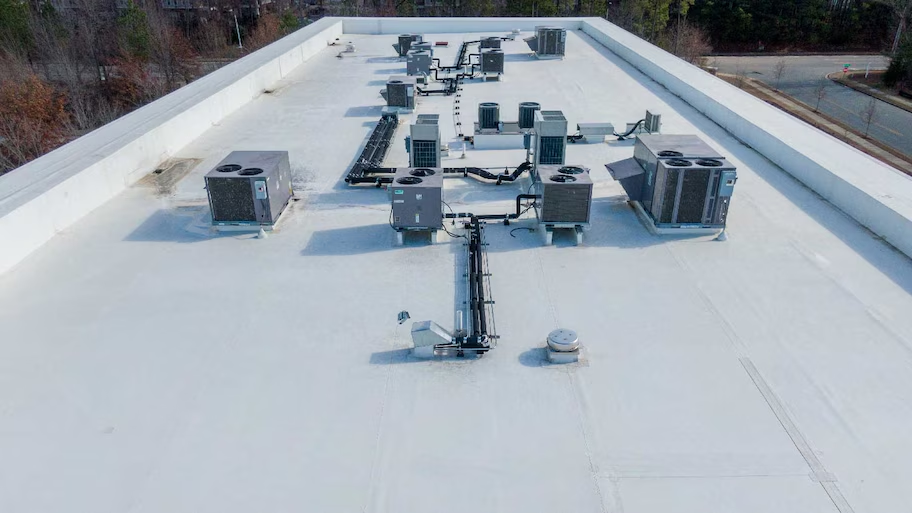
Commercial roofing for Emory businesses
Low-slope roofs fail differently from houses. Water does not run off, it sits, and that changes what matters: seams, terminations, drainage and detail work around everything that comes through the deck.
Everything below is included in the price we quote for commercial roofing in Emory. There is no separate line for showing up, no charge for the inspection, and nothing added afterwards that was not on the estimate you agreed to before the work started.
Drainage and detail work
Drains, scuppers, curbs, parapet terminations and pitch pockets. This is where nearly every low-slope roof we are called to has actually failed. Every Emory property we work on gets this as part of the job.
Roof-mounted equipment
Curbs, sleepers and walkway pads around units that get serviced. Foot traffic on a low-slope roof does real damage when there is nothing protecting the membrane. We do this on every Emory job whether or not anybody thinks to ask for it.
Work staged around your hours
Noisy work scheduled when it does least harm, and the roof left watertight overnight at every point in the job whatever the forecast does. Every Emory property we work on gets this as part of the job.

Why Emory gets its own page
Emory is the Rains County seat and the smallest county seat we work in. The roof stock is modest older housing in town, newer building out toward Lake Tawakoni, and farm property on the county roads. Lake-adjacent property is the distinctive part and behaves differently from anything in town.
We keep a separate page for Emory rather than one page for the whole region because the answers genuinely differ. Roof age, pitch, material and exposure all change what the right job is, and a general page cannot say anything useful about any of them.
Emory is forty minutes from the shop and sits on the route we take toward Canton, so we are through there regularly. There is more about the area on the Emory page, and more about the work on the Commercial Roofing page.
The short version is that we are close enough to Emory to be useful and small enough to care whether the job was right. Both of those matter more in year three than they do on the day.
What Rains County throws at a roof
Rains County sits where storms tracking up from the south-west arrive early, and Lake Tawakoni gives wind a long clear run at anything on or near the shoreline. None of it is dramatic on the day. It is cumulative, and it is why a roof here rarely reaches the number of years printed on the wrapper without somebody looking at it.
All three are gradual, and all three are visible to somebody standing on the roof long before they are visible from the yard. That gap is the reason an inspection is worth having before you need commercial roofing in Emory rather than after.
All of it feeds into what commercial roofing in Emory actually has to address.
Wind exposure
Open ground gives wind a clean run at a roof. Around Emory the properties with the least shelter consistently show the most lifted and creased shingle.
Hail, most springs
Northeast Texas sits where hail is a normal part of spring rather than an unusual event. The question after a storm is how much, not whether.
Time and ultraviolet
Even an untouched roof loses granules steadily to sun and weather. That is the clock running behind every other kind of damage.
What we see on Emory roofs
Exposure is the deciding factor near the water, and it pushes the conversation toward systems with nothing exposed to work loose. Further in, architectural shingle remains the sensible default, with impact-rated lines worth costing out given how often Rains County gets hit.
Emory has been on our regular route for years, largely because it sits on the way to Canton and Van Zandt County rather than off on its own.
What we work on here
Smaller houses in town, a good deal of them older and modestly sized, alongside newer and often larger building toward the water. Outbuildings are common on the county roads, nearly all of them exposed-fastener metal. It is a town where a single street can hold a 1950s house and something built last decade.
Getting to you
Forty minutes out, and on the way to Canton, which means Emory is easy for us to reach without making a special trip. Scheduling there is usually a matter of days.
Who calls us here
Owners of lake-adjacent property as often as in-town homeowners, and the lake side tends to have been through a wind event before and to know exactly what they want looked at.
Almost never in the middle of the field
On an Emory job, on a commercial building in Rains County the membrane itself is rarely the problem. The failures cluster at the edges and around anything that penetrates the deck.
This is why our inspection covers the whole roof rather than the one slope you asked about. Around Emory it is common for the problem you noticed and the problem that matters to be on different elevations.
Standing water
Low-slope is not no-slope. Where positive drainage was never established, water sits after every storm and works at the seams continuously. Regular enough at Emory addresses that we look for it first.
Parapet and edge terminations
Where the roof turns up a wall and stops. Wind gets under a loose termination and peels from the edge inward. Regular enough at Emory addresses that we look for it first.
Wet insulation
Once water is in the insulation it spreads well beyond the entry point, and the roof is heavier and less efficient everywhere it has traveled. It is one of the more common findings around Rains County.
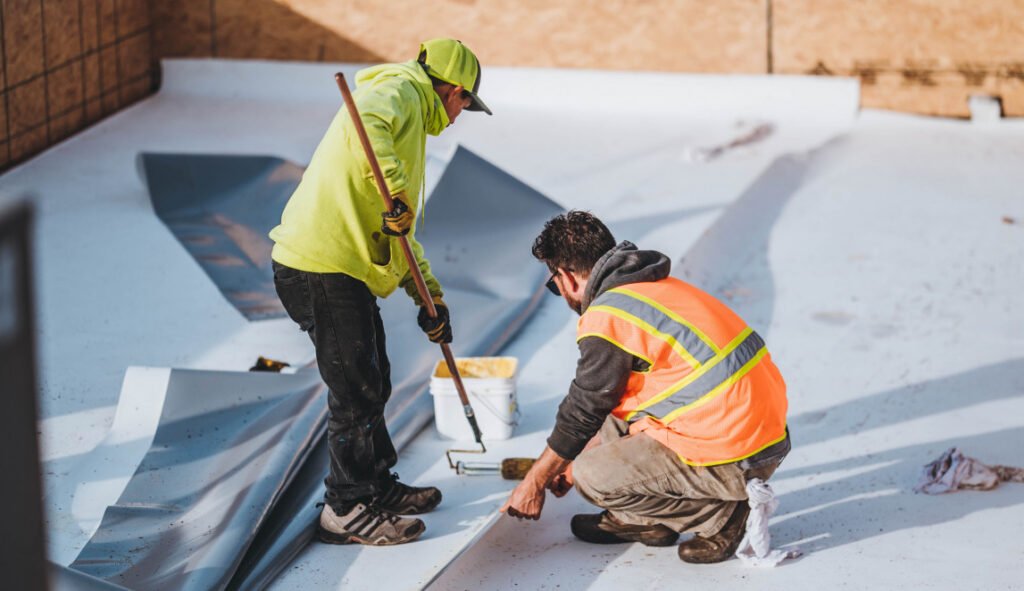
How a commercial job runs in Emory
Commercial work is scheduled around a business rather than the other way round. The sequence does not change; the timing is yours.
You will know who is coming and roughly when at every stage. Eliceo and Daniel handle the calls themselves, so the person you spoke to about the Emory estimate is the person you reach afterwards.
Assessment
The whole roof walked, every penetration and termination photographed, and the drainage pattern checked after rain wherever we can manage it. The same sequence runs at every Emory address.
Written scope
What has failed, what we propose and what it costs, set out so an owner or a board can read it without translation. We follow this on every property we work on around Emory.
Scheduling
Around your trading hours where the work allows it. Most Emory businesses do not need to close for roofing work. It applies whether the Emory job takes an hour or a full day.
Installation
Staged so the building is watertight at the end of every day, whatever the forecast decides to do overnight. It applies whether the Emory job takes an hour or a full day.
Handover
Photographs of the finished detail work, and a walk of the roof with whoever maintains the building. It happens on every Emory job regardless of size.
Six signs an Emory commercial roof needs attention
At an Emory address, low-slope roofs give warning, but the warnings show up inside the building more often than on top of it. These are the ones worth acting on.
You do not need all six to justify a call. Any one of them means something has changed on the roof, and the free inspection will tell you how much it matters and whether it can safely wait until next year.
Ceiling tiles staining
The classic first sign in a commercial building. By the time a tile stains, water has been tracking along the deck for a while. Common enough on Emory roofs that we check for it on every inspection.
Ponding that lasts past two days
Low-slope is not no-slope. Water still sitting forty-eight hours after rain means drainage has failed somewhere. Common enough on Emory roofs that we check for it on every inspection.
Blisters in the membrane
Trapped moisture or air under the surface. Small ones are monitored, large ones are opened up and repaired before they split. We photograph it on every Emory inspection where it is present.
Fasteners showing through the membrane
Backed-out fasteners telegraphing through single-ply is a sign the deck attachment is working loose. Common enough on Emory roofs that we check for it on every inspection.
Soft or spongy areas underfoot
Usually wet insulation rather than a soft deck, and it spreads well beyond where the water got in. This is one of the more frequent findings on a Rains County roof.
Rust at a metal deck edge
On an older building this is structural rather than cosmetic and wants looking at properly. Worth a look from the ground at any Emory address after a storm.
Which low-slope system suits the building
There is no single best commercial roof. There is one that suits the deck, the traffic and the budget of a particular Emory building.
Any of these can be the right answer in Rains County. The wrong answer is the one chosen without anybody looking at the roof first, which is why the inspection comes before the recommendation rather than after it.
Worth reading elsewhere: the National Roofing Contractors Association publishes the low-slope standards this work is built to, and Owens Corning documents the commercial systems we install.
Repair and restoration
Not every commercial roof needs replacing. Where the field is sound, repairing the terminations and details buys real years for a fraction of the cost. It works well on a large share of the roofs we see around Emory.
Insulation and tapered systems
Where a roof has never drained properly, tapered insulation can build the fall in rather than leaving water sitting on a flat deck. It works well on a large share of the roofs we see around Emory.
Tapered insulation
Where a roof has never drained properly, building the fall in with tapered insulation solves the cause rather than patching the symptom every few years. We have put a lot of this on buildings around Emory.
Reinforced detail membrane
Around curbs, drains and pitch pockets, where the roof is cut and sealed back. Nearly every low-slope roof we are called to has failed at one of these. Worth considering on most Emory properties, and we will say when it is not.
What commercial roofing costs in Emory
Commercial pricing is driven by square footage, system and access rather than by a simple per-home figure. These are the variables that actually move it.
The range is wide because Emory properties are. The only honest way to narrow it for commercial roofing in Emory is to get on the roof and measure it, which costs nothing and carries no obligation whatsoever.
Tear-off or overlay
Some systems can go over one existing layer. Whether that is sensible depends on what is under it, which is an inspection question. It is assessed the same way on every Emory job we quote.
Insulation and code
Where a replacement triggers current insulation requirements, that is a real cost and we will flag it at the assessment rather than after. The same method applies to every property we price in Rains County.
Deck repairs
Metal, concrete and wood decks each behave differently once the membrane is off. Priced per area rather than guessed at, and shown to you before anything covers it. The same method applies to every property we price in Rains County.
A repair is often the right commercial answer
Where the membrane field is sound and the failures are at the details, repairing those details costs a fraction of replacement and buys real years. We will tell you which of those an Emory roof is. See TPO roofing for more on the system we install most.
“They did an excellent job on my roof. They were fast and professional. They were respectful and a pleasure to do business with. I am so thankful I chose them.”
 Verified on Facebook
Why Emory property owners call us
Four things worth checking about whoever ends up on your Emory roof. We hold all four and we are happy to evidence every one of them before you agree to anything.
None of it is unusual. It is simply the list we would want answered before letting somebody on our own roof, and we would rather put it in front of you than wait to be asked. All four are things you can check independently rather than take on trust.
Somebody local answers
Eliceo and Daniel handle the calls themselves. There is no call center between you and the people doing the work on your Emory roof. It holds on every job we take in Rains County.
Scheduling in days
Emory is forty minutes from the shop and sits on the route we take toward Canton, so we are through there regularly. Most weeks we can have somebody at an Emory address within a few days, and an active leak moves to the front of the queue. No exceptions, on any Emory address.
A warranty that means something
Ten years on our workmanship, in writing, on top of whatever the manufacturer covers on the material itself. Two different things covering two different failures. The same on an Emory repair as on a full replacement.
4.9 across 76 reviews
Published on Google and Facebook, unfiltered, and a good share of them from Rains County. You can read every one of them at the source. That has been true for every Emory job since 2015.
Towns near Emory
These are the towns we are usually working in the same week as Emory. If your address is closer to one of them, start there instead: the pages carry the roof stock and storm history specific to each.
Other roofing work in Emory
The other jobs we handle at Emory addresses. If what you need is not commercial roofing, it is almost certainly on this list, and each one has a page of its own.
We keep a page per job per town rather than one page for everything because the honest answers differ. Roof age, pitch, material and exposure all change what the right work is at an Emory address, and a page written for the whole region cannot say anything useful about any of them.
Questions we get about commercial roofing in Emory
A properly installed and maintained TPO or modified bitumen roof commonly gives twenty years or more. What shortens it is almost always neglected detail work rather than the membrane wearing out in the field.
Twice-yearly inspections are what make the difference. Catching a lifting seam or a failed pitch pocket in year eight keeps a roof on course for twenty; finding it in year fourteen usually does not. If it matters for a decision you are making about an Emory property, ask us and we will give you the specific answer rather than the general one.
Yes, and it is a normal part of low-slope work. Units, conduit and ductwork all have to be lifted, flashed around or reset, and the detail work around them is where most commercial roofs actually fail. We photograph every one of them before and after so there is a record of how each was left. That is the general picture. What it means for your Emory roof is a question the photographs answer better than we can here.
We will schedule recurring inspections with photographs, which is what most building owners actually want. Catching a lifting seam or a failed pitch pocket early is the difference between a sealant repair and a replacement, and on a commercial roof that gap is measured in tens of thousands. If it matters for a decision you are making about an Emory property, ask us and we will give you the specific answer rather than the general one.
Yes. We provide documentation in a form a carrier or a facilities manager can work from: dated photographs by area, a written scope and the costs in writing. What we do not do is negotiate a claim, which is a separate regulated role. For an Emory address we would rather look at the roof than answer it in general terms, and looking costs nothing.
Yes, and the detail work around units, curbs and conduit is usually where the roof is actually failing. Where equipment has to be lifted or reset we coordinate that rather than working around it badly. The honest answer for any particular Emory property depends on what is actually up there, which is what the free inspection establishes.
Book a free Emory roof inspection
A few details is all we need to get a free inspection booked at your Emory address. We will walk the roof, photograph what we find and put a price in writing, and none of that costs you anything.
Get Your Free Quote
Enter your details below and we will get back to you with a real number.
Start with a look at the roof.
Call us, or send the form and we will call you back. The inspection is free, the photographs are yours, and any quote for commercial roofing in Emory comes to you in writing.
Ask us about commercial roofing in Emory and we will tell you plainly what the roof needs.