The short version
- Storm prep is less expensive than storm repair, and the window to do it is before the season starts.
- Clear the gutters, trim branches back from the roof plane, and secure anything that can become a projectile.
- Photograph the roof while it is undamaged. That set of photos is what makes a later claim straightforward.
- Check flashing, vent boots and the seal around penetrations. Those fail before the field of the roof does.
- After a storm, document from the ground first and do not climb a wet or damaged roof.
- A documented inspection ties damage to a dated weather event, which is what an adjuster needs.
Learning how to prepare your roof for storm season is one of the smartest moves a Northeast Texas homeowner can make, because the region sees some of the most active hail and severe weather in the country every spring. A little preparation before the storms arrive can mean the difference between a roof that holds and a roof that leaks, and it puts you in a far stronger position if you do need to file a claim. This checklist walks you through how to prepare your roof for storm season step by step.
Why Storm Prep Matters in Northeast Texas
Hopkins County and the surrounding area sit squarely in a hail corridor, with damaging hail, high winds, and severe thunderstorms common from spring into early summer. Roofs that are already worn, poorly maintained, or missing shingles are the ones that fail when a storm hits. Taking time to prepare your roof for storm season reduces the chance of damage, helps your roof survive what it does face, and creates a record of your roof’s good condition that supports any future claim.
How to Prepare Your Roof for Texas Storm Season
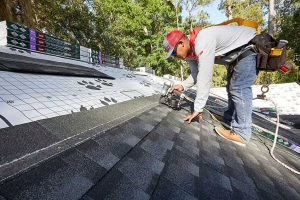
- Get a professional inspection. Have a roofer check the roof before the season so any weak spots are fixed in advance.
- Replace missing or damaged shingles. Gaps are where wind and water get in, so close them before the storms.
- Check and clean the gutters. Clogged gutters back up water onto the roof edge and fascia during heavy rain.
- Secure or trim trees. Trim branches that overhang the roof so wind cannot drive them into your shingles.
- Inspect flashing and seals. Make sure flashing around chimneys, vents, and valleys is intact, since these are common leak points.
- Check attic ventilation. Good ventilation helps the roof handle temperature swings and moisture.
- Document the current condition. Take dated photos of your roof in good shape, which helps prove storm damage later.
Strengthen the Roof Before the Season
If your roof is aging or you have already been through a hail claim, storm season is a good time to consider an upgrade. Class 4 impact-resistant shingles are built to survive hail that would damage standard shingles, and they may earn you an insurance discount. Metal roofing offers even greater durability against wind and hail. If a full replacement is on the horizon anyway, doing it before storm season rather than after a failure saves you the stress and the emergency pricing. Compare options on our roof replacement page and our metal roofing page.
What to Do During and After a Storm
During a storm, stay inside and away from windows. Afterward, do a careful ground-level check for missing shingles, dents on gutters and vents, and any debris, and look inside the attic for new leaks or stains. Do not climb onto a wet or damaged roof yourself. If you suspect damage, get a professional inspection promptly, because hail damage is often invisible from the ground and the sooner it is documented, the stronger your insurance position. Our storm damage page and insurance claims page walk you through the next steps.
Why Northeast Texas Homeowners Call DJJ Roofing
DJJ Roofing has helped Northeast Texas homeowners prepare for and recover from storm seasons since 2018. We provide free pre-season inspections, fast post-storm response, and the documentation insurance adjusters require. We are fully insured, a BBB Accredited Business, Google Guaranteed, and an Owens Corning Preferred Contractor, with a 4.9 star rating across 76 Google reviews, based at 124 Como St S in Sulphur Springs. Call (903) 217-5431 to get your roof storm-ready.
When Storm Season Actually Runs Here
Northeast Texas has two distinct severe periods rather than one. The primary storm season runs roughly from March into June, peaking in April and May, and it is the one that produces most of the hail this region claims for. A secondary storm season arrives in the fall, usually October and November, and it is shorter but not gentle.
Summer is not quiet either. Isolated storms through July and August tend to be wind events rather than hail, and a single downburst can strip a roof edge without a cloud of hail ever forming.
Knowing the calendar matters because preparation has a deadline. Work done in February is preparation. The same work in May is repair.
Start With the Roof Edge
Wind does not lift a roof from the middle. It gets under an edge and peels inward, which is why nearly every wind claim starts at a rake, an eave, or a ridge.
Before storm season, the edges are the first thing worth looking at. Starter course lifting along the eave, shingles at the rake that have lost their seal, or a ridge cap with raised tabs all give wind the purchase it needs.
From the ground with binoculars you can see more than people expect. Look along each edge for a line that is not straight, for tabs standing slightly proud, and for any course that has shifted out of alignment with the ones beside it.
Trees: The Damage You Can Actually Prevent
Most storm damage is unavoidable. Tree damage largely is not, and it is the single most productive thing a homeowner can do before storm season.
- Trim anything overhanging the roof. A branch that touches in a breeze will scour granules in a storm.
- Clear deadwood. Dead limbs come down first and they come down hard.
- Mind the pecans. They shed large limbs readily and they are common across this region.
- Look at what leans. A tree already leaning toward the house is the one to deal with before storm season, not after.
- Keep a six-foot gap between branches and the roof surface where the species allows it.
Trimming is also the least expensive of all the storm season jobs, and the only one that reduces the odds of a total loss rather than a repair.
Check the Attic Before the Season, Not After
The attic is where a roof tells the truth. It is also the one part most homeowners never look at until water is already coming through a ceiling.
Take a flashlight up on a bright day and turn it off for a moment. Daylight through the deck is a hole, and it will find water in the first storm of the season. Then look at the underside of the sheathing for dark staining around nails or along seams, which indicates past leaks or condensation.
Press on any area that looks discolored. Sound decking is firm. Soft decking is a replacement, and it is far better discovered in February than during the first hail event of storm season.
Gutters and Drainage Before the Rain
A storm delivers a year’s worth of water in an hour, and a blocked gutter turns that into overflow against the fascia and the wall below.
Clearing gutters before storm season is routine. What gets missed is the downspout and where it discharges. A clear trough feeding a packed downspout still backs up, and a downspout emptying at the base of the wall puts a large volume of water into the soil against the foundation exactly when the ground is already saturated.
Run a hose through each run and watch the far end. Water should arrive quickly and leave cleanly. Anything that pools, drips behind the trough, or takes its time is worth fixing before the season rather than during it.
Photograph the Roof While It Is Undamaged
This is the step almost nobody takes and the one that pays the most if a claim ever follows.
Before storm season, photograph the roof from all four sides, plus the gutters, any flashing you can see, and the attic decking. Date-stamped images of an intact roof establish its condition beforehand, which removes the most common argument in a disputed claim: whether the damage predated the storm.
Phone photos from the ground are enough. They do not need to be close or artistic. They need to exist and to carry a date.
Keep them somewhere off the phone as well, because a claim can arrive a year later and phones get replaced.
Know Your Policy Before You Need It
Insurance is not a storm season task in the practical sense, but reading the policy is, and it takes twenty minutes.
- Find your wind and hail deductible. It is often a percentage of the dwelling value rather than a flat figure, and it is usually larger than the all-peril deductible.
- Check whether roof coverage is replacement cost or actual cash value. That single distinction can change a settlement substantially on an older roof.
- Look for a cosmetic damage exclusion, which some policies apply to metal roofs.
- Note the claim filing deadline. Texas policies commonly require prompt notice, and the clock starts at the date of loss.
The Texas Department of Insurance publishes plain-language guidance on homeowners coverage at tdi.texas.gov, and reading it before storm season is considerably less stressful than reading it afterward.
What Is Worth Fixing Before the Season
Not every imperfection needs attention in February. Some genuinely do, because they are the points where a storm turns a sound roof into a claim.
- Loose or lifted shingles, especially along edges and ridges.
- Failed pipe boot collars, which crack with age and are a common leak source.
- Flashing that has pulled away at a chimney, wall, or skylight.
- Exposed or backed-out fasteners on a metal roof.
- Missing sections of ridge cap.
- Soft decking found in the attic.
Each of those is a small job on a calm day. Each is also the place a storm starts. If any of them turn up, a roof repair before storm season costs considerably less than the same work as emergency response.
What Not to Do
A few well-meant preparations do more harm than good, and they come up often enough to be worth naming.
Do not pressure wash a shingle roof. It strips granules, which are the roof’s protection against sun and impact, and it can drive water under the courses. Do not apply sealants or coatings across a shingle field in the hope of storm-proofing it; asphalt shingles are designed to shed water by overlap, and a coating interferes with that.
Do not walk the roof unnecessarily, particularly in heat. Warm asphalt scuffs under foot and a single careless trip across a roof can cost it granules it will not get back before storm season.
What to Keep on Hand
After a storm, the useful items are the ones already in the garage. Supply runs are difficult in the days following a regional hail event.
- A heavy tarp and a roll of rope, sized for a section rather than the whole roof.
- A bucket or two for interior drips.
- Your policy number and agent’s contact written down, not only stored on a phone.
- A working flashlight for the attic if the power is out.
After the Storm: The First 48 Hours
What you do immediately afterward shapes the claim more than anything else.
Start inside. Check the attic and the ceilings for water before climbing anything. Photograph everything you find, including the date on a phone, and photograph the ground too: dented gutters, a battered air conditioner fin, hail on the grass. Adjusters treat that collateral evidence seriously because it corroborates the event.
Then stop the water if you safely can, and call for an inspection rather than climbing up to investigate. Roofs are slick after rain and the damage is often not where the leak appears.
The National Weather Service maintains storm reports for this area at weather.gov/fwd, which is useful for establishing the date of loss if it is ever questioned.
Why a Pre-Season Inspection Is Worth It
Everything above is something a homeowner can do. An inspection covers the part you cannot see from the ground, and before storm season it does two jobs at once.
The first is finding the small failures that turn into claims: a lifted starter course, a cracked boot, a section of flashing that has moved. The second is establishing a documented baseline of the roof’s condition, which is exactly what a disputed claim turns on later.
Our roof inspections are free and they take about an hour. If the roof is sound we will tell you that, which is a reasonable thing to know heading into storm season. If something needs attention, February is a better time to hear it than May.
If a storm has already been through, the insurance claims process is its own subject and we cover it separately. The preparation above is what reduces how often you need it.
What Hail Actually Does to a Roof
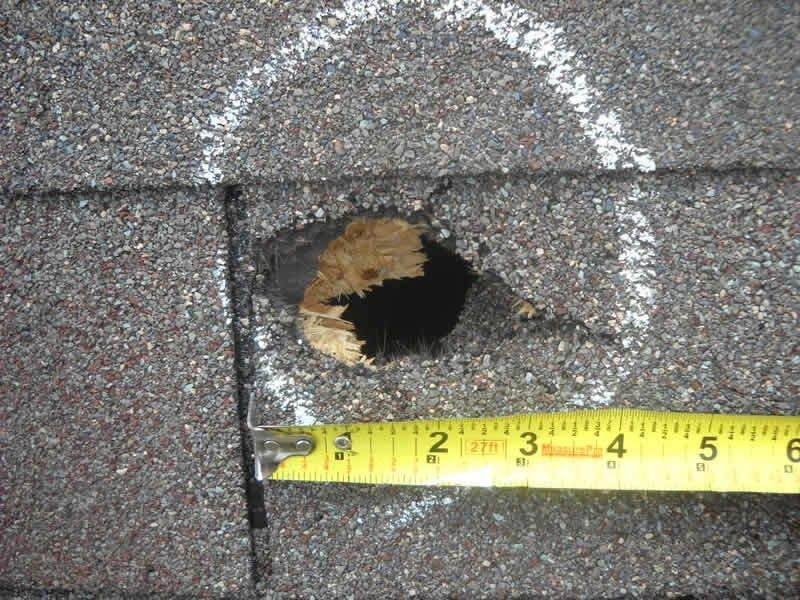
It helps to know what you are preparing against, because hail damage is often invisible from the ground and homeowners routinely assume a roof came through fine when it did not.
On asphalt shingles, hail rarely punches holes. It bruises. The impact fractures the mat beneath the surface and knocks granules loose, leaving a soft dark spot that sheds more granules with every following rain. The shingle still looks whole. Its remaining life has been cut substantially.
That is why post-storm inspections look for granule loss in gutters and for bruising you can feel rather than see. It is also why a roof can pass a glance from the driveway and still have a legitimate claim behind it.
Soft metals tell the story first. Gutters, downspouts, roof vents, and the fins on an air conditioner dent visibly at hail sizes that only bruise shingles. If those are marked after a storm season event, the roof was hit at the same intensity.
Metal Roofs and Storm Season
Metal handles hail differently, and preparation shifts accordingly.
A standing seam roof conceals its fasteners under the seam, so hail that dents a panel is usually cosmetic rather than a leak path. The weather surface is uninterrupted. That is a genuine advantage in this climate and one reason metal is common on shops and barns here.
An exposed-fastener panel is a different assembly. Every screw passes through the panel into the purlin beneath, sealed by a rubber washer. Those washers age, and wind and thermal movement can back a screw out over years. Before storm season, walking a metal roof to check for backed-out fasteners and cracked washers is the equivalent of checking shingle edges.
Panel ends and ridge closures matter too. A closure that has shifted lets wind-driven rain travel under the panel, which shows up as staining on the purlins long before it shows on a ceiling. If you own metal roofing, those are the points worth a look each year.
Shops, Barns and Outbuildings
Preparation tends to concentrate on the house and skip everything else on the property, which is understandable and occasionally expensive.
Shops and barns are usually lower slope, frequently metal, and often older than the house. They also tend to have longer unbroken runs of roof, which gives wind more to work with. A detached building that loses panels in a storm can damage the house it lands against.
The same checks apply: fasteners, closures, edges, and anything overhanging. If an outbuilding is covered on the same policy as the house, it is worth documenting before storm season alongside everything else.
Building It Into the Calendar
None of this is difficult. The reason it does not happen is that storm season arrives on its own schedule and preparation has to be deliberate.
- January or February: trim trees, clear gutters, photograph the roof, read the policy.
- Late February: attic check and a pre-season inspection, with any small repairs booked.
- Through the spring: after any significant event, a quick look at gutters for granules.
- September: a shorter repeat before the fall storm season.
Two mornings a year covers all of it. Set against the cost of a claim that gets disputed because nobody photographed an intact roof, it is a reasonable trade.
If You Rent, or the Roof Is Not Yours
Tenants and landlords both get caught out by storm season, usually over who was supposed to do what.
In most Texas residential leases the structure is the landlord’s responsibility and the contents are the tenant’s. That means the roof, the gutters and the tree work sit with the owner, while damage to furniture and belongings sits with a renter’s policy if one exists.
The practical advice for a tenant is to report anything you can see before the season rather than after: a stained ceiling, a drip in a closet, daylight in a garage. Photograph it and send it in writing. For an owner at a distance, a pre-season inspection is the only reliable way to know the condition of a roof you are not standing under.
Frequently Asked Questions
How do I prepare my roof for storm season in Texas?
Get a professional inspection, replace missing or damaged shingles, clean the gutters, trim overhanging branches, check flashing and ventilation, and document the roof’s current condition with dated photos.
When is storm season in Northeast Texas?
Severe weather and hail are most common from spring into early summer, though storms can occur at other times. Preparing your roof before spring is ideal.
Should I upgrade my roof before storm season?
If your roof is aging or you have had a hail claim, Class 4 impact-resistant shingles or metal roofing offer stronger protection and may reduce your insurance premium.
What should I do right after a storm?
Check from the ground for missing shingles and dented metal, look in the attic for leaks, avoid climbing a damaged roof, and get a professional inspection promptly to document any damage.
Does storm prep help with insurance claims?
Yes. Dated before photos and a recent inspection establish your roof was in good condition, which strengthens a storm damage claim.
Get storm-ready now. Schedule a free pre-season roof inspection with DJJ Roofing. Call (903) 217-5431 or contact us.